Casio CMK-100: The Titanium Automatic That Takes Casio Beyond Edifice

Casio has spent the time since mid-2025 proving it can build a mechanical watch, and it has done it entirely under the Edifice name. The EFK-100 arrived in June 2025 as the brand’s first automatic, a 39 mm steel case, 12.5 mm thick, running a Casio module built on the Seiko NH35 with a 40-hour reserve. The EFK-110D and EFK-200 followed with textured dials and a 42-hour movement, and the EFK-200 now sells for 299 euros in Casio’s Spanish store. Good watches, but every one of them carries Edifice’s sport-inspired styling.
The CMK-100 drops that look. It is a 38 mm titanium field watch with a sapphire crystal, 100 m of water resistance and an automatic movement, and as far as I can find it is the first Casio automatic that doesn’t carry the Edifice name. Casio files it under its CASIO AUTOMATIC range, and the Spanish store places it in the Timeless Collection. This is a watch for someone who wants a light, plain, everyday mechanical and was never going to buy a motorsport dial.
That makes the fair comparison an internal one. The Edifice EFK-200 costs the same 299 euros in the Spanish store, is the same 38 mm wide and matches the CMK-100 on the movement sheet line for line. Titanium field watches at this level exist elsewhere, as our list of affordable field watches worth buying right now shows, but the CMK-100 mostly has to beat the steel watch on its own shelf. On paper, it does.

Titanium Is Doing the Heavy Lifting
The case measures 38 mm across, 11.4 mm thick and 44.7 mm long, in titanium with ion plating and a titanium carbide coating against scratches. Crown and caseback both screw down, the crystal is sapphire, and water resistance is 10 bar.
The weight is the real change. The nylon versions come in at 55 g and the leather ones at 54 g, while the solid titanium bracelet takes the CMK-100TD-1A to 98 g. Casio lists the steel EFK-200D-2A at 153 g and the EFK-110D-1A at 143 g, so the titanium bracelet version is lighter by roughly a third. It is also thinner, 11.4 mm against 11.9 and 11.8 mm, though at 44.7 mm long it runs a little longer than the 43.6 and 43 mm Edifice cases. It is the one comparison I would trust before seeing a single wrist shot.

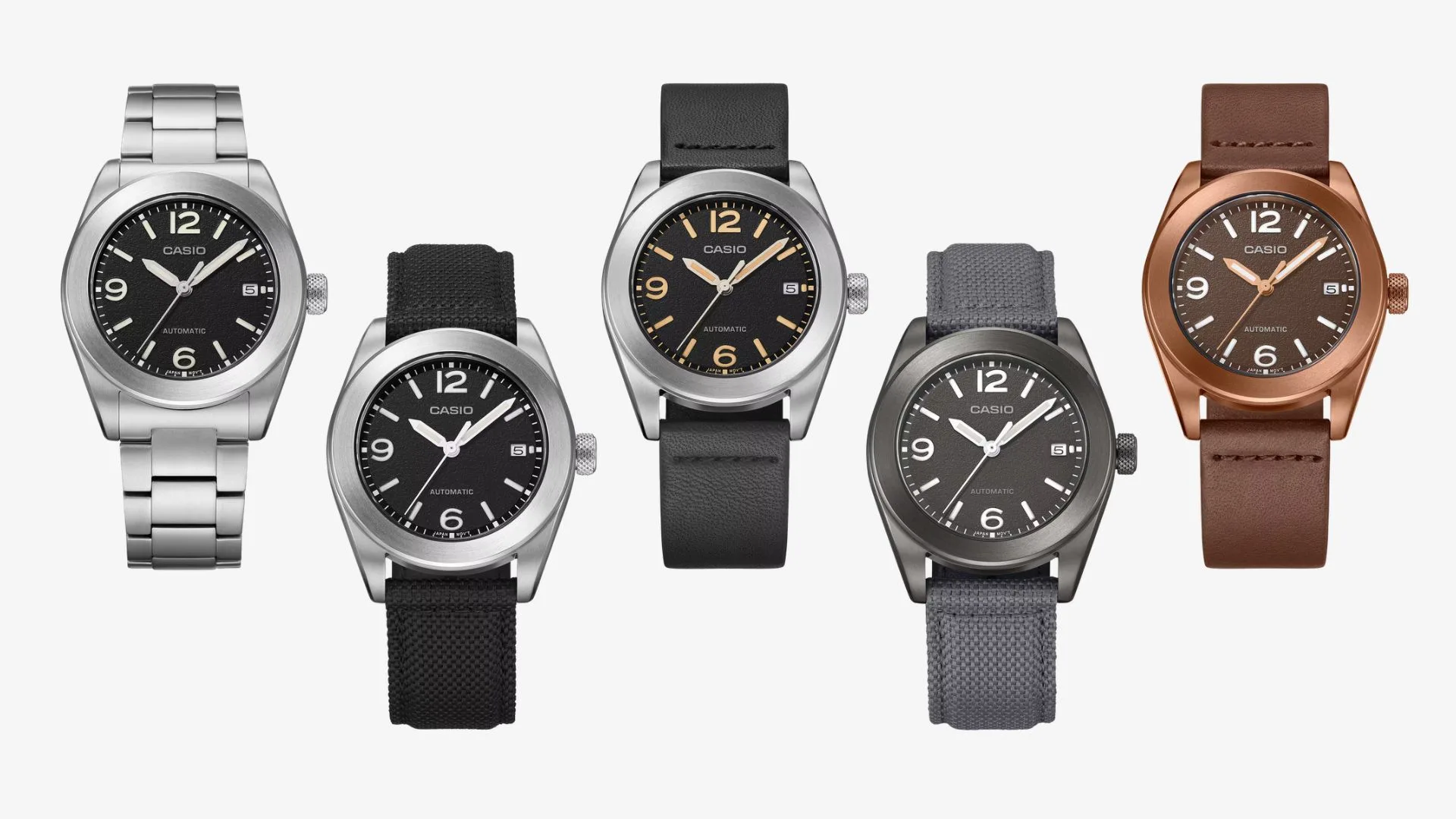
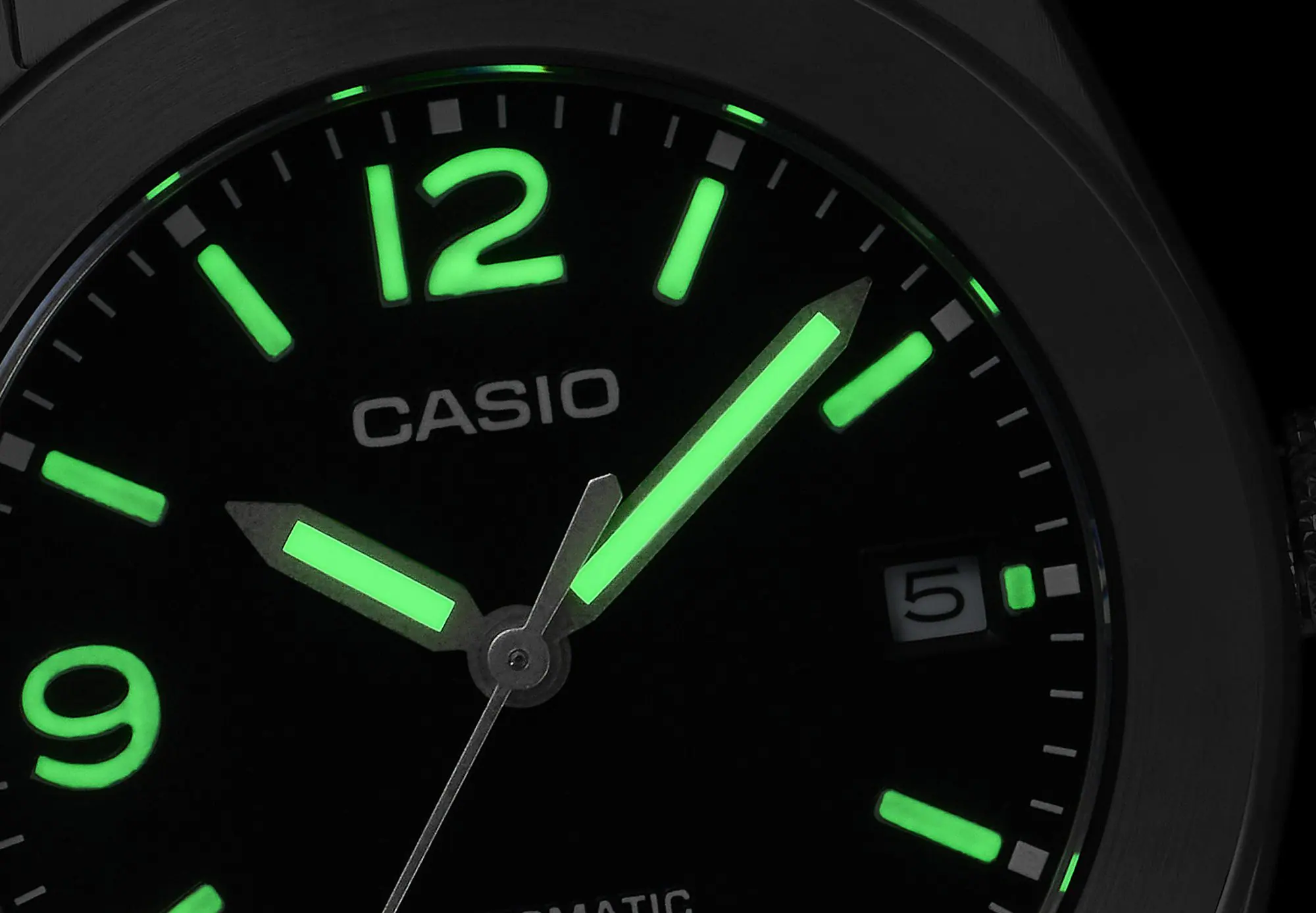
Casio’s own photos show large Arabic numerals at 12, 9 and 6, plain baton markers for the other hours and the date window sitting where the 3 would be. That reads as a nod to the Explorer-style 3-6-9 layout, with the date taking the place of one numeral, and it is the least Edifice thing about the watch. The dial has a fine stamped texture, the numerals and markers use layered luminous paint, and the hands are filled with lume too. It is a field-watch dial dressed in Explorer logic, not a copy of one.
Same Movement Numbers, Different Watch Around Them
Casio names no caliber on the CMK-100 sheet, or on the EFK-110D and EFK-200 sheets. What it gives is identical on all three: Made-in-Japan automatic, hand winding, a hacking seconds hand, 21 jewels, 21,600 vph, about 42 hours of reserve and a rate of -20 to +40 seconds a day. The pre-launch leaks said the CMK-100 uses the Miyota 8215, and Casioblog attributes the same movement to the two Edifices, although one Vietnamese retailer lists a Casio module numbered 5766 for the CMK-100. It would not be surprising if all three share a Miyota, but until Casio says so the name stays unconfirmed. The NH35-based EFK-100 is the odd one out.

If it is an 8215, it is also the cheapest part in the watch. Our look at why affordable movements keep getting more expensive put the 8215 at roughly $29 to $34 wholesale, against $45 to $57 for the NH35 family, which could help explain how Casio keeps sapphire at 299 euros. The trade-offs are the usual ones: a loose rate window, and at 21,600 vph the seconds hand moves in small steps rather than gliding.
The Edifice Still Has a Case to Make
The EFK-200 does a few things the CMK-100 sheet does not. Both Edifice sheets list a see-through screw-down caseback, while Casio describes the CMK-100 only as screw-down, so assume a solid back until photos say otherwise. Steel suits people who want a heavier, more tool-like feel, and Edifice’s racing-inspired dials are a taste, not a flaw.

For a watch that will see desks, trains and the odd trail, though, the CMK-100 is arguably the stronger package on paper: the same movement numbers, the same 100 m, the same price on nylon, a much lighter case and a plainer face that goes with more. The Edifice wins if you want the exhibition back. The Casio wins everywhere else I can check from a spec sheet.
The Bracelet Is the Hard Sell
Casio’s Spanish store lists the CMK-100TC-1A on nylon at 299 euros, the leather CMK-100TL-1A at 319 and the titanium-bracelet version at 399, all with VAT and all still marked as coming soon. That puts the nylon on the same price as the steel EFK-200, which is the whole argument for it. No US price has been announced. The leaks guessed 280 to 300 dollars, so the Spanish figures sit above that once converted. Two more references, a gray dial on nylon and a brown dial on leather, are in Casio’s global range but not yet on the Spanish store.

The bracelet costs 100 euros more than that steel Edifice for 55 g less on the wrist. That is a fair price for solid titanium links and a three-fold clasp, and a poor price for a watch with the same movement numbers. It is also the point where what the AVI-8 CVRT already offers under 400 euros starts to matter.
Go further up and RZE’s titanium Resolute 36 at $680 shows what a Miyota 9039 and a 9.5 mm case cost once you leave this bracket. Casio is not trying to play there, and it shouldn’t.
Specs, Pricing & Availability
Case Diameter: 38 mm
Case Thickness: 11.4 mm
Case Material: Titanium with ion plating and titanium carbide coating
Water Resistance: 100 m (10 bar)
Caliber: Japanese Automatic
Crystal: Sapphire
Function: Hours, minutes, seconds with hacking, date
Price: 299 euros (CMK-100TC-1A, nylon), 319 euros (CMK-100TL-1A, leather), 399 euros (CMK-100TD-1A, titanium bracelet)
I’d Take the Bracelet and Buy Straps Later
My pick is the titanium bracelet at 399 euros. You do not get a solid titanium bracelet on a sub-400 automatic every day, and straps are cheap to add later, so the bracelet version gives you both. The nylon at 299 euros is the value pick, or the leather at 319 if Tuscan vegetable-tanned leather appeals more. Keep the Edifice only if you want the see-through back or a steel bracelet for 100 euros less.
The bigger story is what the name signals. Casio gave this line a new prefix and a new look, which reads as mechanical becoming a permanent branch of the catalogue, not an Edifice experiment. For Edifice, the immediate effect is an in-house rival with the same movement numbers and a lighter case.
Check out The Ultimate Affordable Watches Guide