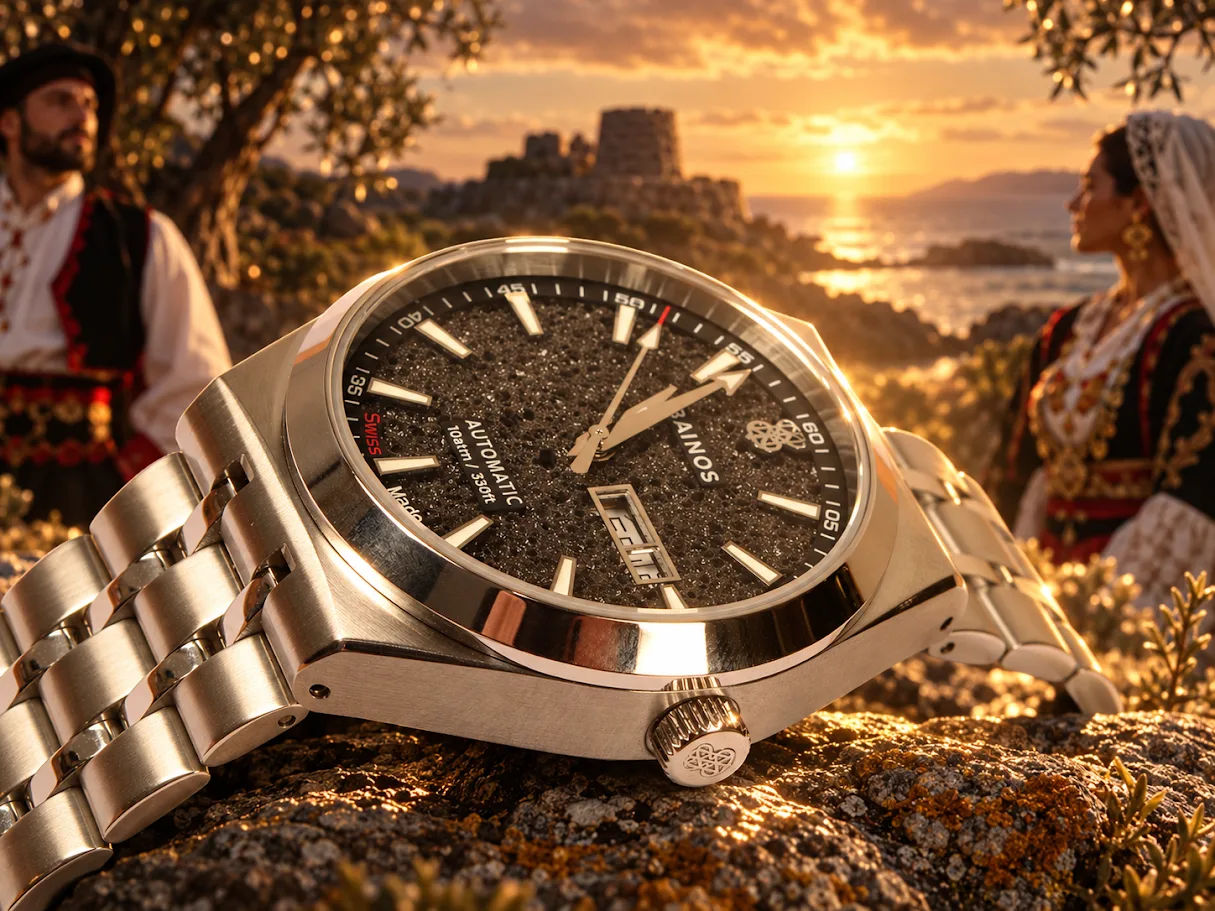
BAINOS Origine Shardana Edition: Real Sardinian Basalt

Stone dials have stopped being a curiosity. Baltic now sells four stone-dial Prismic models as part of its permanent range, from around €1,300, and Straum cut wafers of volcanic basalt for a 100-piece edition that cost €1,900 before VAT. Real stone has become a trend, and it has stayed expensive.
A new Sardinian brand called BAINOS wants to break that pattern. Its Origine Shardana Edition puts a dial made from basalt extracted on the island into a 41mm steel case, with a Swiss Sellita SW220-1 automatic inside, at a moment when mechanical movement prices keep climbing for everyone. Campaign pricing starts at €749 for the first 20 watches, and the whole edition is capped at 100 numbered pieces.
The closest rival is Straum’s Jan Mayen Basalt, and the comparison is a revealing one. Both are limited to 100 pieces, both are 11.5mm thick, both are rated to 100 metres and both sit on an integrated steel bracelet. BAINOS matches that list for well under half the money, which is either the story or the warning, depending on how the campaign goes.

Same Stone Idea, Less Than Half the Price
Side by side, the two read like cousins. Straum sets a basalt wafer on a coated brass base inside a 38.7mm case, runs a La Joux-Perret G101 movement and asks €1,900 excluding VAT. BAINOS offers a 41mm case, a Sellita SW220-1 and a campaign price of €749 or €860.
Arguably the stronger package on paper is BAINOS, because it matches the spec sheet at a fraction of the cost. Straum keeps the better movement and, more importantly, a record of delivering watches. BAINOS has a prototype and a campaign page.
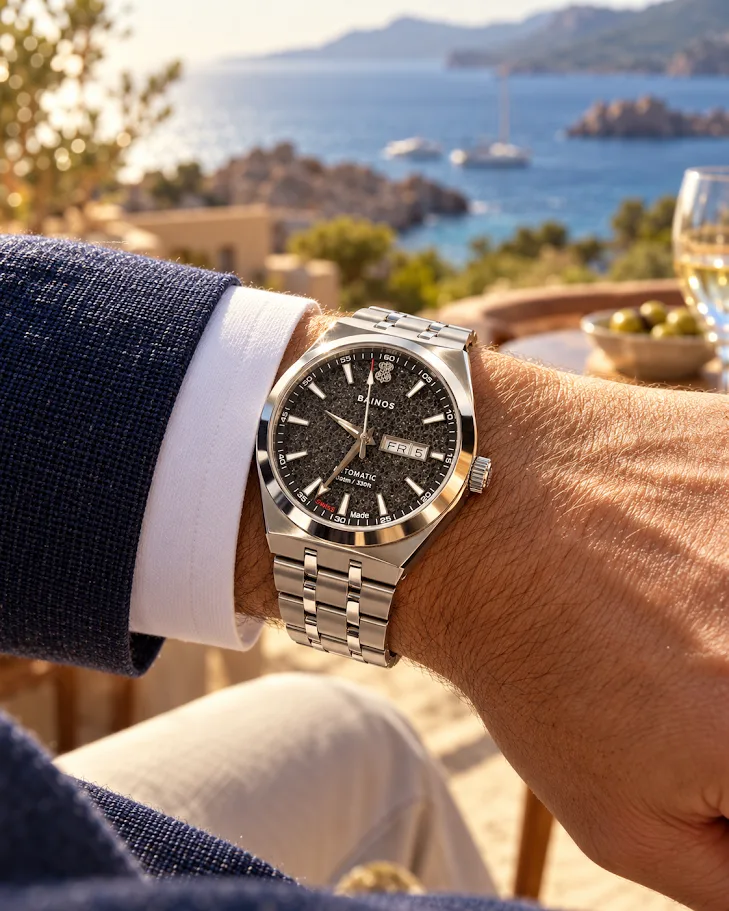
The brand calls Origine the first Swiss automatic with a Sardinian basalt dial. That sentence is carefully built, because basalt dials are not new. Straum uses rock from Jan Mayen, and the crowdfunded Igneous Santa Maria used Guatemalan basalt over a Seiko NH35. What is new here is the island, not the material.
Raw quarry basalt is grey, rough and porous, so BAINOS describes four stages. The stone is sanded through 400, 800 and 1200 grit to a smooth surface, then treated with a compound that permanently darkens it from anthracite to deep black. Only the densest areas are polished afterwards, so the natural pores stay matte. The finished slab is fixed to a brass base with standard Swiss dial feet.
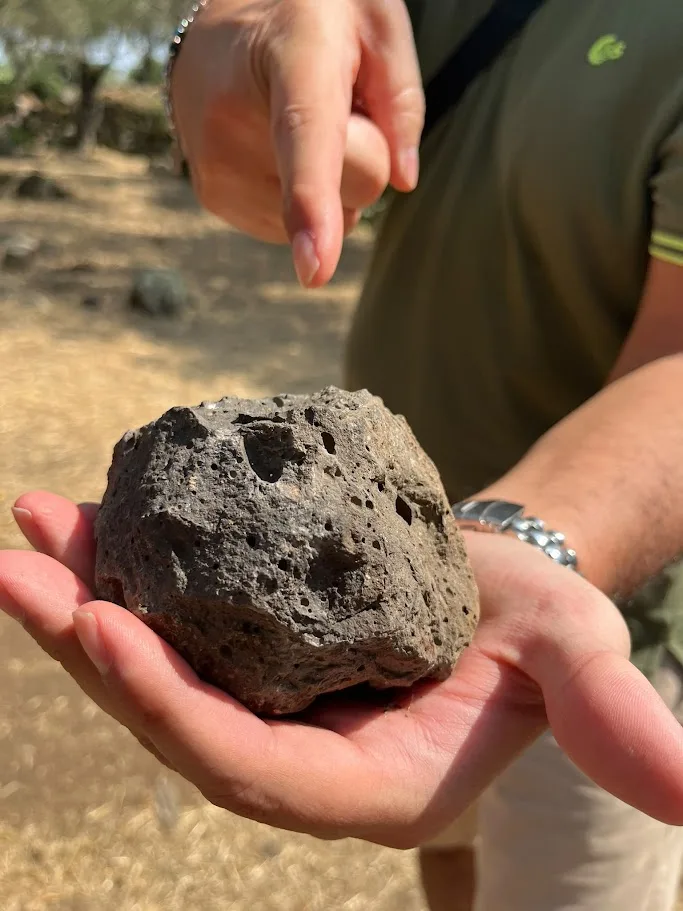
The selective polish is the clever part. Glossy stone beside matte pores gives the dial a depth that a printed texture cannot imitate, and it is why no two dials will match. It also means the black is a treatment, so treated basalt is the honest description. The founder, Roberto Orecchioni, says twelve factories refused the project before a thirteenth agreed to try. I can’t verify that, but a rough, porous stone is a poor starting point for a dial, so it sounds plausible. Because every dial differs, the prototype photographs show one possible dial, not necessarily yours.
The SW220-1 is a familiar workhorse: an automatic with a 38-hour power reserve, built as Sellita’s equivalent of the ETA 2836-2. BAINOS points out that any certified watchmaker can service it, which holds for the whole SW200 family. I have spent time with that family in the Sellita-powered Vesora Gantry I reviewed, although that is the hand-wound SW210-1b, a cousin and not the same caliber.
The Made-in Story Is Honest, but Swiss Covers One Part
Credit where it is due. BAINOS says plainly that the basalt is extracted and worked in Sardinia, the movement is Swiss, and the steel case, bracelet and final assembly come from partners in Asia, built to its own drawings. Design, development and quality control stay in Sardinia. Like most microbrands at this price, it works this way, and the plain admission is welcome.
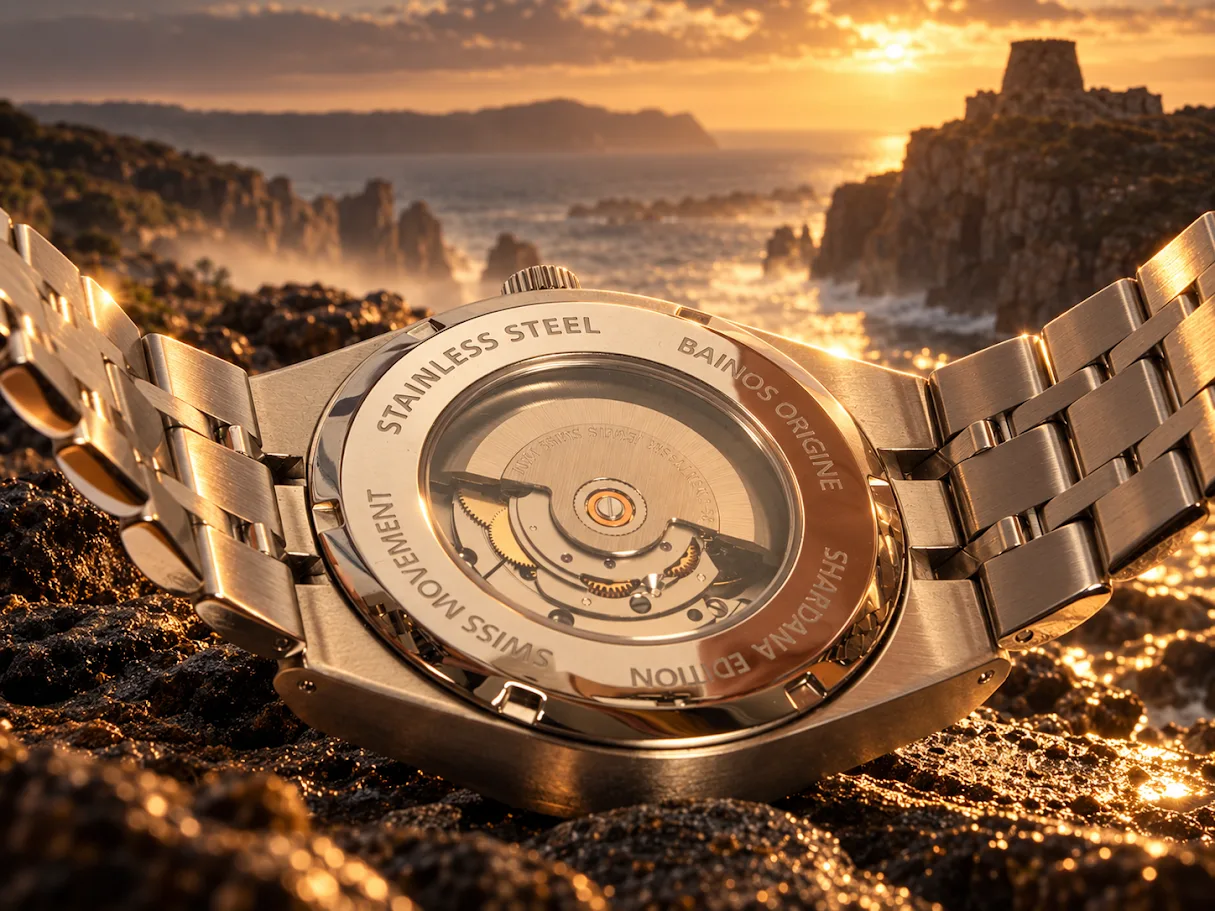
It does mean that Swiss in the headline claim refers only to the movement. At 41mm and 11.5mm thick on an integrated bracelet, the missing lug-to-lug figure also matters, because that number decides whether the watch sits properly on a wrist. I would want it before pledging.
The €749 Tier Is a Pledge, Not a Price
The Kickstarter launch is scheduled for today, October 28, 2026. The first 20 watches cost €749, the other 80 cost €860, and BAINOS plans a retail price of €1,390. That makes the 46 percent saving quoted for the early tier a discount from a price nobody has paid yet. Shipping is extra, import duties and taxes fall on the backer at delivery, and production is estimated at 60 to 65 working days after orders are confirmed.
Backing a crowdfunded watch means how microbrand pre-orders really work applies in full: you pay first and wait. Campaign prices also rarely last. Trafford started on Kickstarter from $399, and its Sellita-powered Crossroads Core now costs $899 on pre-order. BAINOS’s own planned €1,390 shows the same gap.
Specs, Pricing & Availability
Case Diameter: 41mm
Case Thickness: 11.5mm
Case Material: 316L stainless steel
Water Resistance: 100m (10 ATM)
Caliber: Sellita SW220-1, automatic, 38-hour power reserve
Crystal: Anti-reflective sapphire
Function: Hours, minutes, seconds, date at 3 o’clock
Price: €749 (first 20) and €860 (remaining 80) on Kickstarter; planned retail €1,390
Who Should Back It, and Who Should Wait
If a real stone dial under €900 is the draw, the first 20 pledges are where the maths works, and I would take one of those over the €860 tier. The dial idea is sound, the movement is dependable, and Baltic’s permanent stone models start roughly €440 above the dearer BAINOS price.
Wait for finished watches if you need certainty on fit, dial consistency or a Swiss made label. The questions I would put to BAINOS before the campaign opens are the lug-to-lug measurement, whether the day wheel is used, and how much the dials will vary.
If it ships on time, the bigger story is price: stone dials under €900 would make Baltic and Straum explain what the extra money buys. If it slips, it becomes one more reminder that crowdfunding is a bet.
Check out The Ultimate Affordable Watches Guide