
Nubeo’s recent space watches have followed one rule. Go large, load the dial with something nobody else is doing, and let the licence carry the price. The Apollo One Small Step set a real sliver of lunar meteorite into the caseback of a 48mm case and asked $590 for it. The Tranquility suspended a 3D-printed planet inside a 48mm case 20.75mm thick and asked $540. Even the skeletonised Console, which turned an actual NASA heliophysics mission into a dial, arrived as a statement object rather than a watch you would wear on a Tuesday.
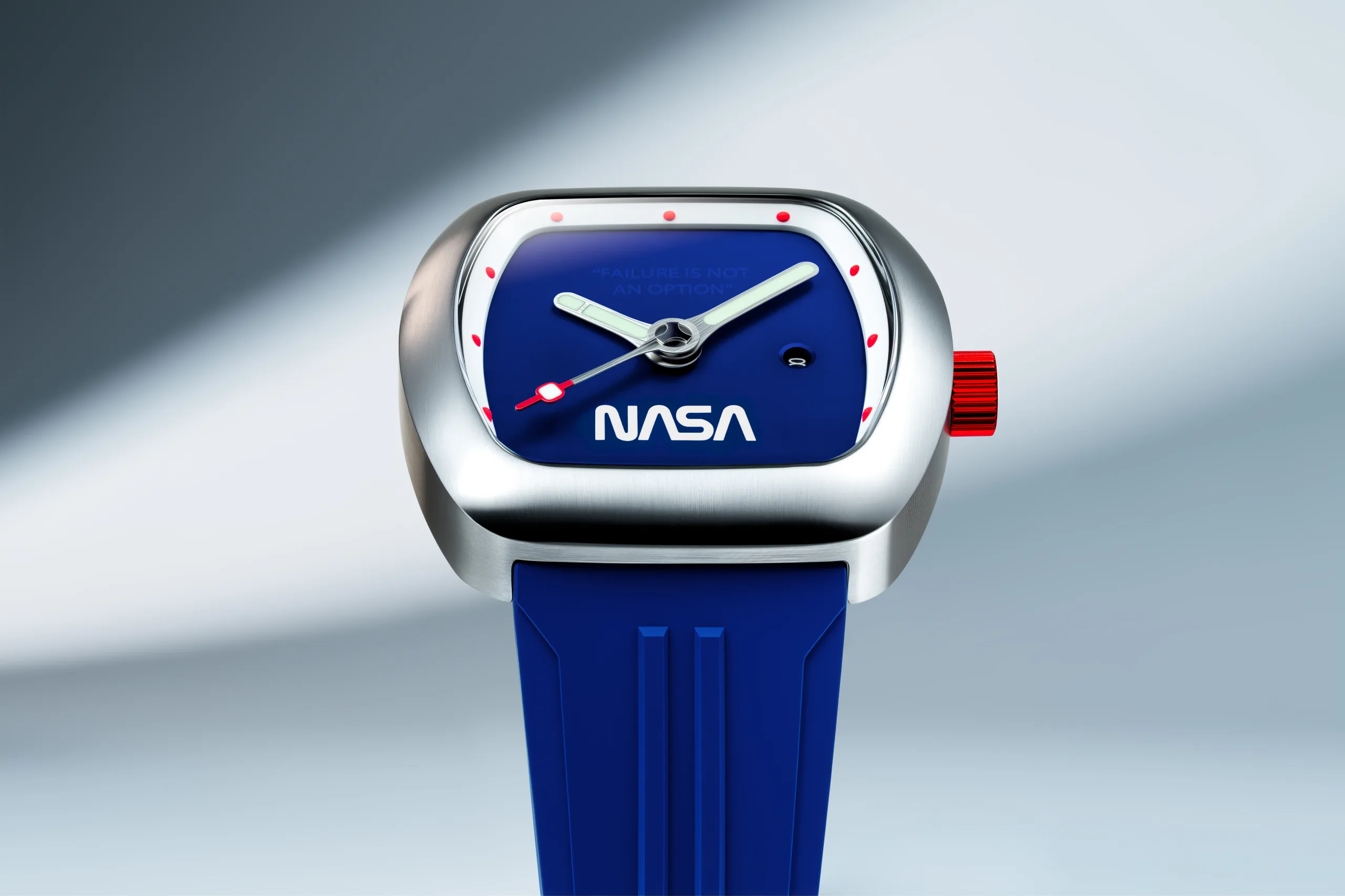
The Elysium Automatic NASA Limited Edition goes the other way on every count. It is a 45mm barrel-shaped steel case, 13.5mm thick, 48mm lug to lug, on a rubber strap, at $300. Three colourways of 150 numbered pieces each go on sale on 24 September 2026. Against the Apollo and the Console, it is the first of the brand’s NASA pieces built to be worn rather than displayed.
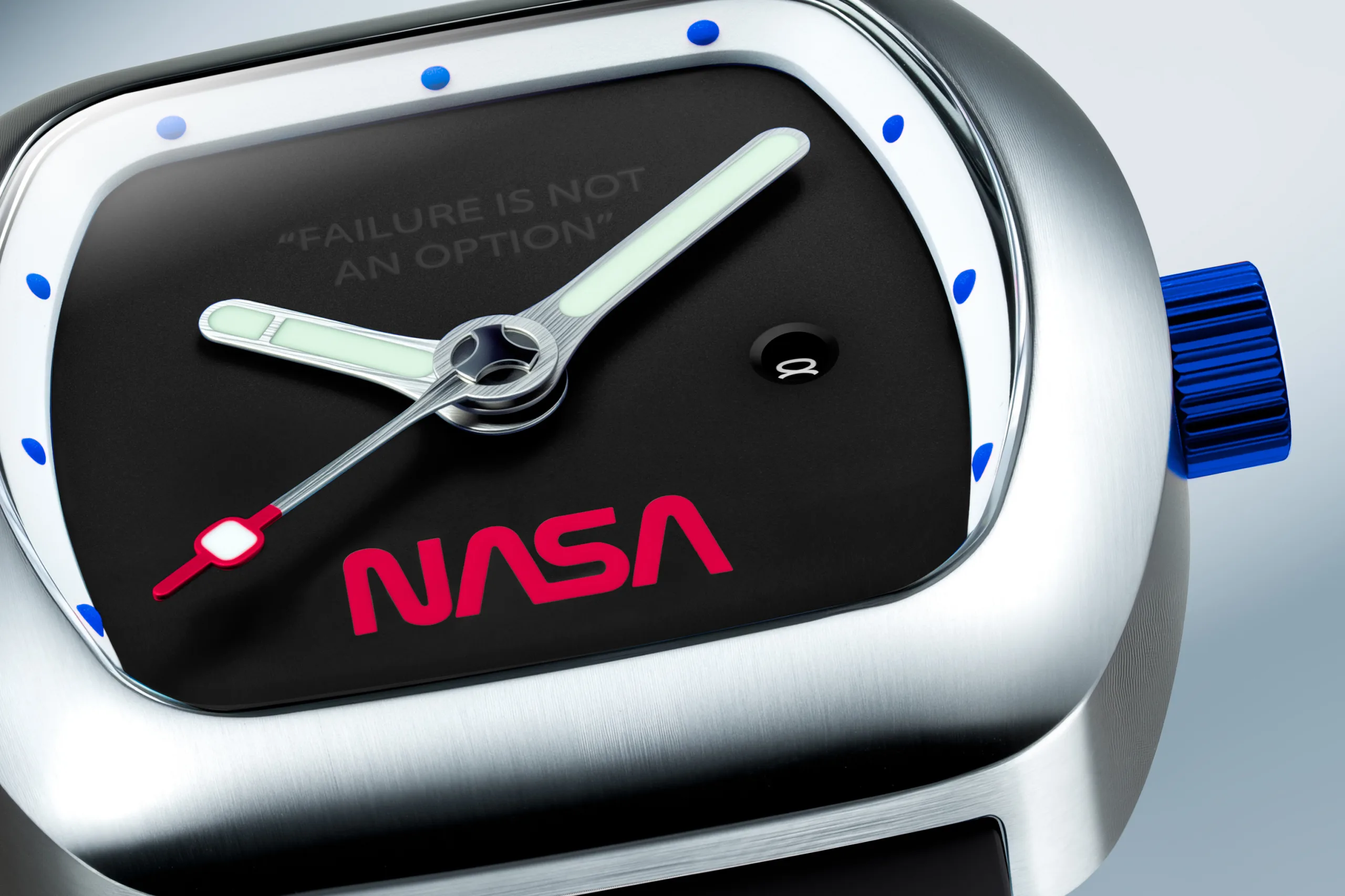
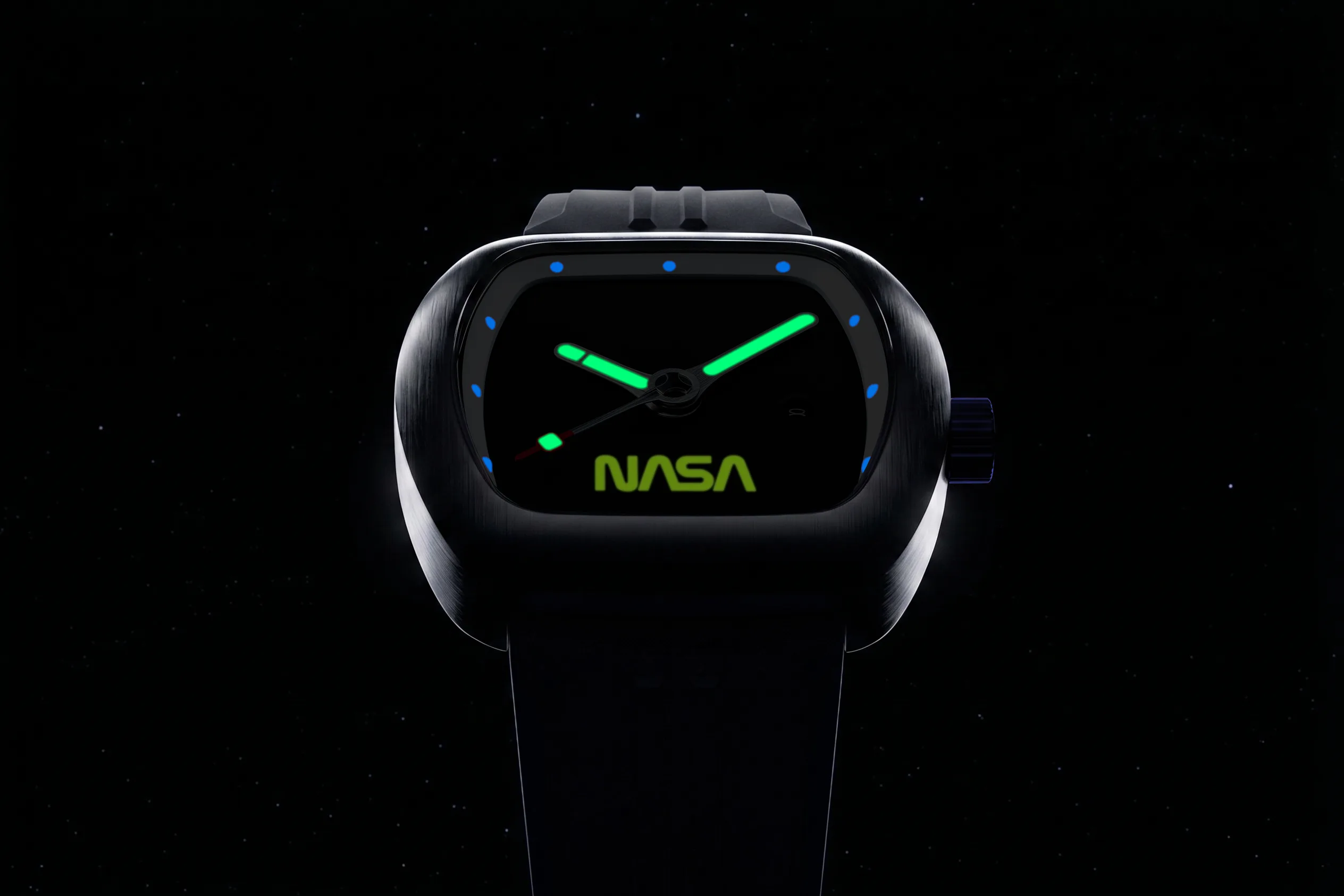
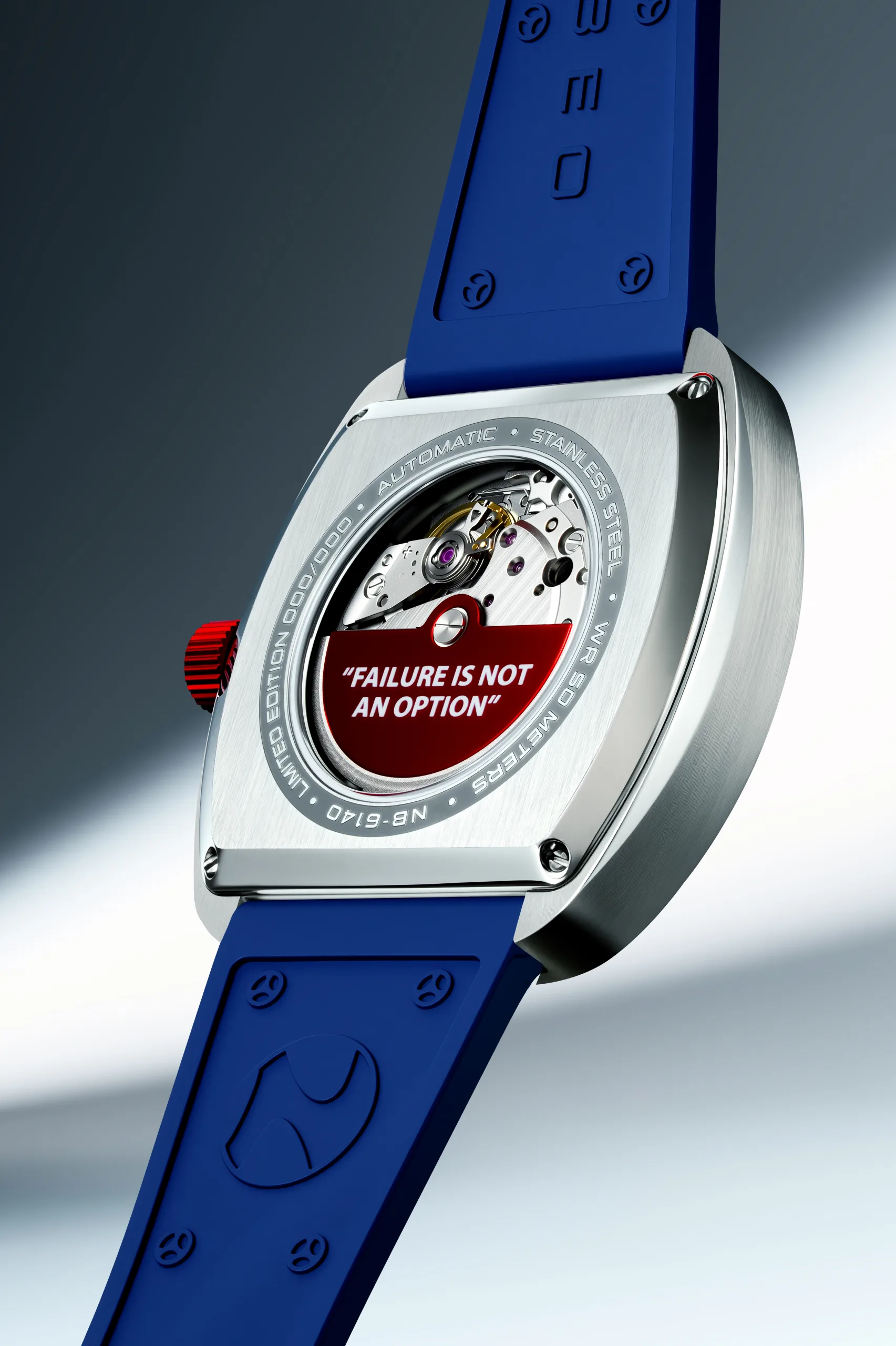
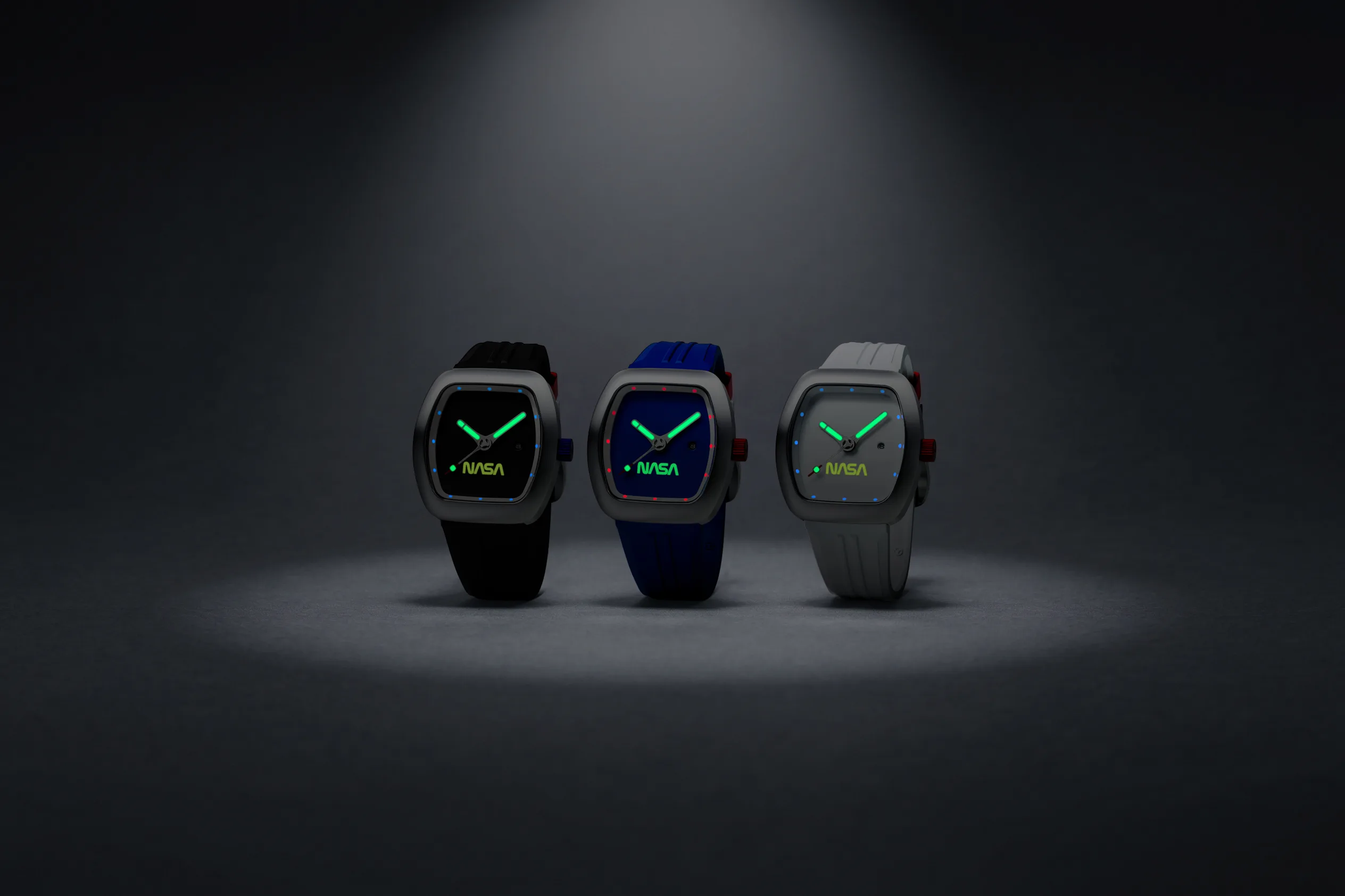
What it sells instead of hardware is a sentence. The dial carries the NASA worm logotype and the words “Failure is not an option,” printed plainly across the face, then repeats the phrase as a hidden line on the rotor that only appears under UV light. That is the whole concept, and it is worth knowing where the sentence actually comes from.
Nobody at Mission Control Ever Said It
Nubeo credits the phrase to Apollo 13 and the composure of NASA’s Mission Control. The mission is real, the composure is real, the line is not. It was written for the 1995 Ron Howard film, built by the screenwriters out of an interview with flight dynamics officer Jerry Bostick, who had said the team never considered failure an option. Gene Kranz, the flight director Ed Harris plays saying it, never said it in 1970. He liked it enough to use it as the title of his memoir five years after the film came out, which is how it became NASA folklore in reverse.
None of that makes it a bad thing to print on a watch. A phrase that traveled from a screenplay into the vocabulary of the agency it was written about is a better story than the sanitised version, and it is the kind of detail a brand’s own page never includes. If the Apollo 13 mission itself is the draw, the more interesting horological thread runs through the Speedmaster that Snoopy ended up attached to, where the award and the mission are genuinely connected.
The Case Shape Is the Actual Design Decision
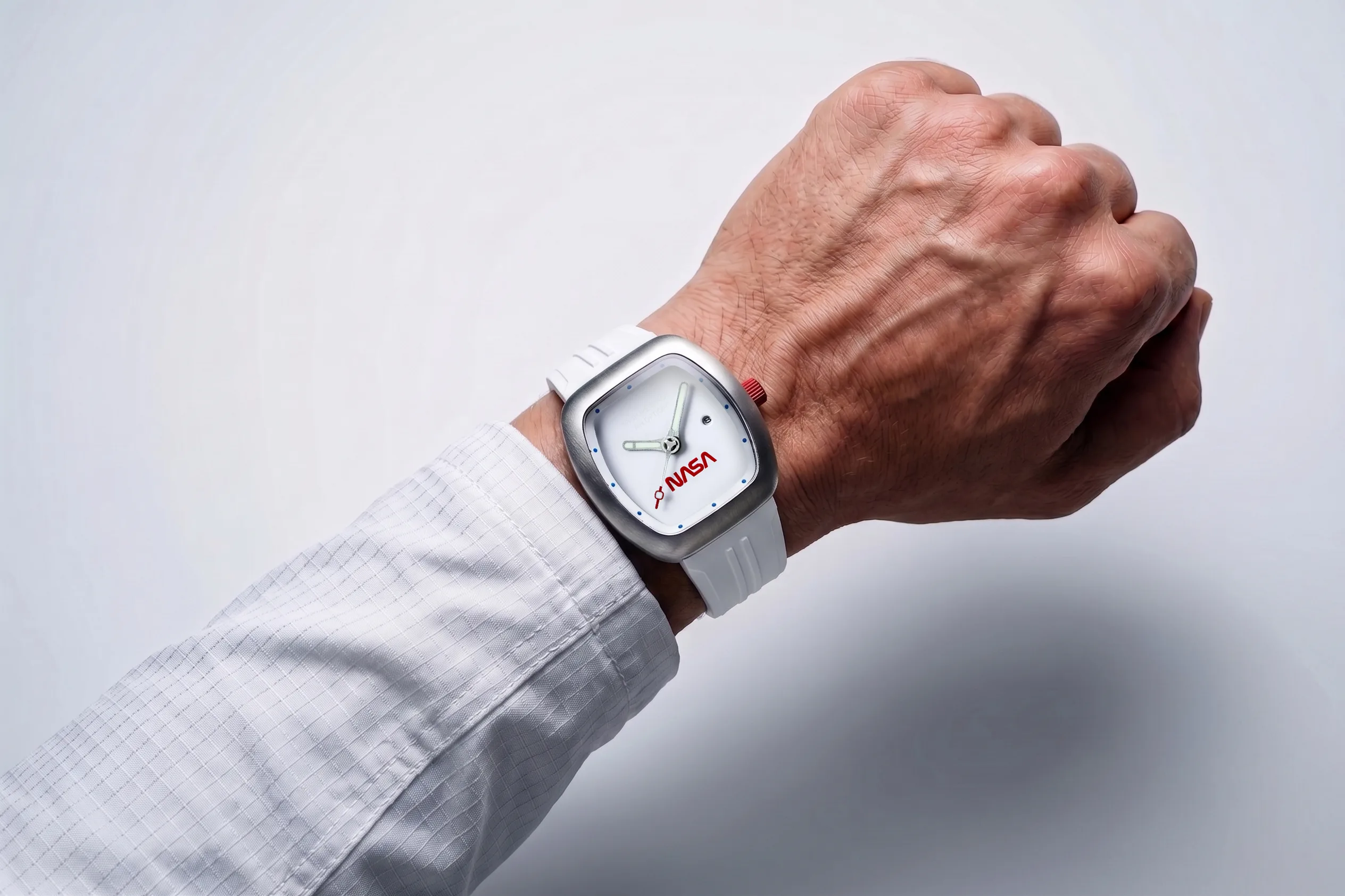
A 45mm barrel case with a 48mm lug to lug wears nothing like a 45mm round one. The Tranquility’s 56mm lug to lug ruled out most wrists before the strap was buckled. Eight millimetres less span, seven millimetres less height, and the Elysium lands in territory where a 7 inch wrist is not automatically disqualified.
The case is brushed and polished steel with a fixed steel bezel, which keeps the barrel outline clean and gives the dial the full width of the watch. A matte dial, applied nothing, a red or contrast crown, and the worm logotype sitting slightly below centre. It reads more like a late-1970s cushion-case quartz watch than anything in Nubeo’s current catalogue, and that is the most appealing thing about it.
The crown pulls out rather than screwing down, which is the tell for the 5 ATM rating. This is a watch you wear in the rain and the shower, not in the sea.
At $300 the Compromises Are in the Right Places
The lens is mineral with an anti-reflection coating, not sapphire. On a $540 or $590 Nubeo that would be hard to defend. Here it is the honest consequence of a price that has come down by nearly half, and the $300 bracket where this now competes is full of watches making exactly the same trade. Mineral scratches where sapphire does not, so a buyer who is rough with a watch should know that going in.
What survives the cost-cutting is more interesting than what did not. The exhibition caseback is screwed rather than pressed, the rotor is engraved rather than printed, each piece is marked with its number out of 150, and the strap is a 26mm rubber on a signed buckle rather than the generic silicone that usually shows up at this price. The packaging is a NASA-branded protective case, which for this buyer is not a throwaway detail.
The Movement Is the Cheapest Part, and It Should Be
Inside is a Japanese Miyota automatic, listed as M-MIY-8215-D3, with three hands and a date. The 8215 is the most predictable choice available and that is the point of it. It has been in watches from $150 upwards for decades, every watchmaker knows it, parts are everywhere, and it will still be running long after the box has been thrown away.
It is also a caliber this site has lived with. The integrated-bracelet Duxot that runs the same movement came in at roughly +12 seconds a day over a review period, which is unremarkable and entirely usable. At 21,600vph the seconds hand steps rather than glides, so anyone expecting a smooth sweep across that matte dial should adjust their expectations.
Expecting more at this price has become unrealistic anyway. The cost of entry-level Japanese and Swiss automatics has moved steadily upward, and a 9-series Miyota in a limited edition at $300 is not a thing the market currently produces.
Nobody Licensed Anything Here
Worth clearing up, because every affordable brand gets this wrong in its own marketing. NASA does not license its insignia. Its merchandise team reviews artwork and approves or rejects it, and the agency’s own brand guidance states plainly that there are no licensing agreements, no fees and no exclusivity. Any company can submit a mockup, and any company that follows the guidelines can get the worm on a dial.
That reframes the $300. A Star Trek or an Atari edition carries a real royalty that the buyer pays for somewhere in the price. This one does not, which means the money went into steel, a rubber strap and a movement rather than into a rights holder. It also means the badge confers nothing exclusive. There is no reason another microbrand cannot put the same logotype on a similar watch next quarter, and several already have.
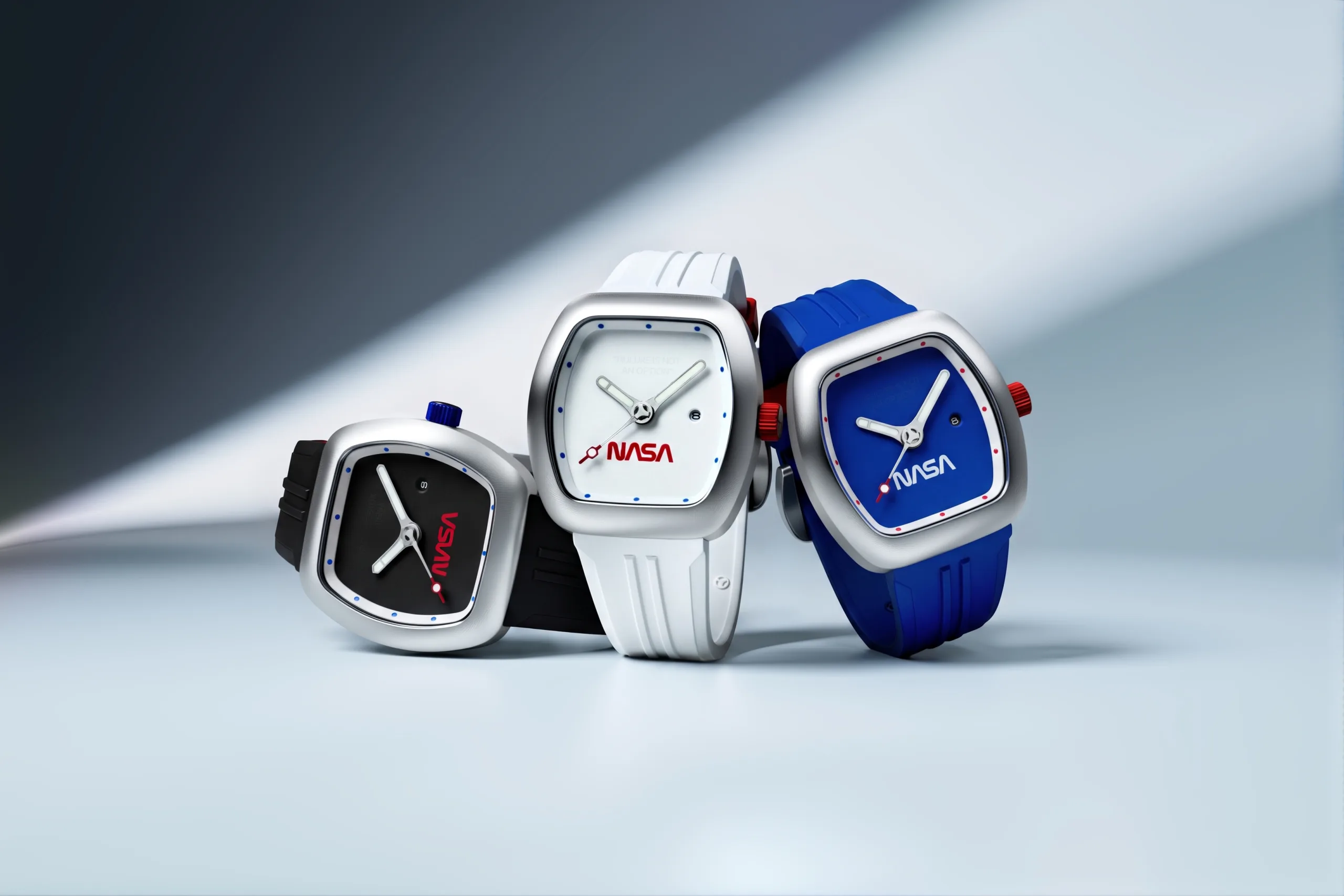
Cosmic Navigator (NB-6140-01), Dark Frontier (NB-6140-02) and Blue Galaxy (NB-6140-03).
Three references at 150 each is 450 watches, and Nubeo’s limited editions have a consistent history of ending up well under list price once the launch window closes. There is already a 20 percent promotion running on the brand’s own store as this goes live, which tells you most of what you need to know about how firm $300 is.
The edition number is worth exactly as much as the buyer’s attachment to the phrase on the dial, and no more. If you want a specific number or the packaging intact, order it in the first weeks. If you just want the watch, patience has historically been rewarded with this brand.
Specs, Pricing & Availability
Case Diameter: 45mm (48mm lug to lug)
Case Thickness: 13.5mm
Case Material: Stainless steel, brushed and polished, fixed steel bezel
Water Resistance: 5 ATM
Caliber: Japanese Miyota automatic, M-MIY-8215-D3, three hands and date
Crystal: Single-curve anti-reflection coated mineral lens
Function: Hours, minutes, seconds, date; self-winding; exhibition caseback with engraved rotor; UV-reactive dial detail
Price: $300 USD
Who Should Buy One
I would buy the Blue Galaxy, and I would buy it as the first Nubeo I could imagine wearing regularly. The barrel case at 13.5mm is a genuinely wearable proposition, the price is finally aligned with what is inside, and a watch that puts a misattributed film line under UV on its rotor has a better sense of humour than most character-branded product.
What I would not do is buy it for the badge alone. If the NASA connection is what you are after and you want something with more historical weight behind it, the Console built around the IBEX spacecraft is a more serious object, and the Timex x NASA collaborations sit at similar money with the Q case doing the heavy lifting. Skip this one if you need sapphire, if you swim in your watches, or if 45mm on any case shape is beyond your comfort.
For Nubeo, this is the most sensible thing the brand has done in a while. The Apollo and the Tranquility both asked the buyer to accept 48mm and north of $500 to get the concept. This one asks for neither, and if it sells, it should reset what the next NASA piece looks like.