
Duxot has leaned hard into the integrated bracelet, the 1970s luxury sports watch format that most affordable brands now borrow in some form. I already wore and reviewed the round version of that idea, and my Taranto review ended up surprisingly positive for a $310 watch. The Quadrata collection is the other side of the brand: square integrated-bracelet watches, with a fixed bezel set with exposed screws and a bracelet that grows straight out of the case.
The new Quadrata 24 Hour Automatic adds a 24-hour register and a running small seconds to that case, on a smoked fumée dial. It goes on sale on September 25, 2026, from $320, which is exactly what the all-steel Aqua Luxe I have been wearing costs. If the silhouette looks familiar, it should: this is the design language of the Patek Philippe Cubitus, finished to a standard I did not expect at this price, for less than one percent of what Patek asks.
I have worn it almost everywhere since it arrived: the office, dinners, evenings out with friends. It is also coming with me to a wedding soon, paired with a suit, and I am looking forward to that more than I expected.
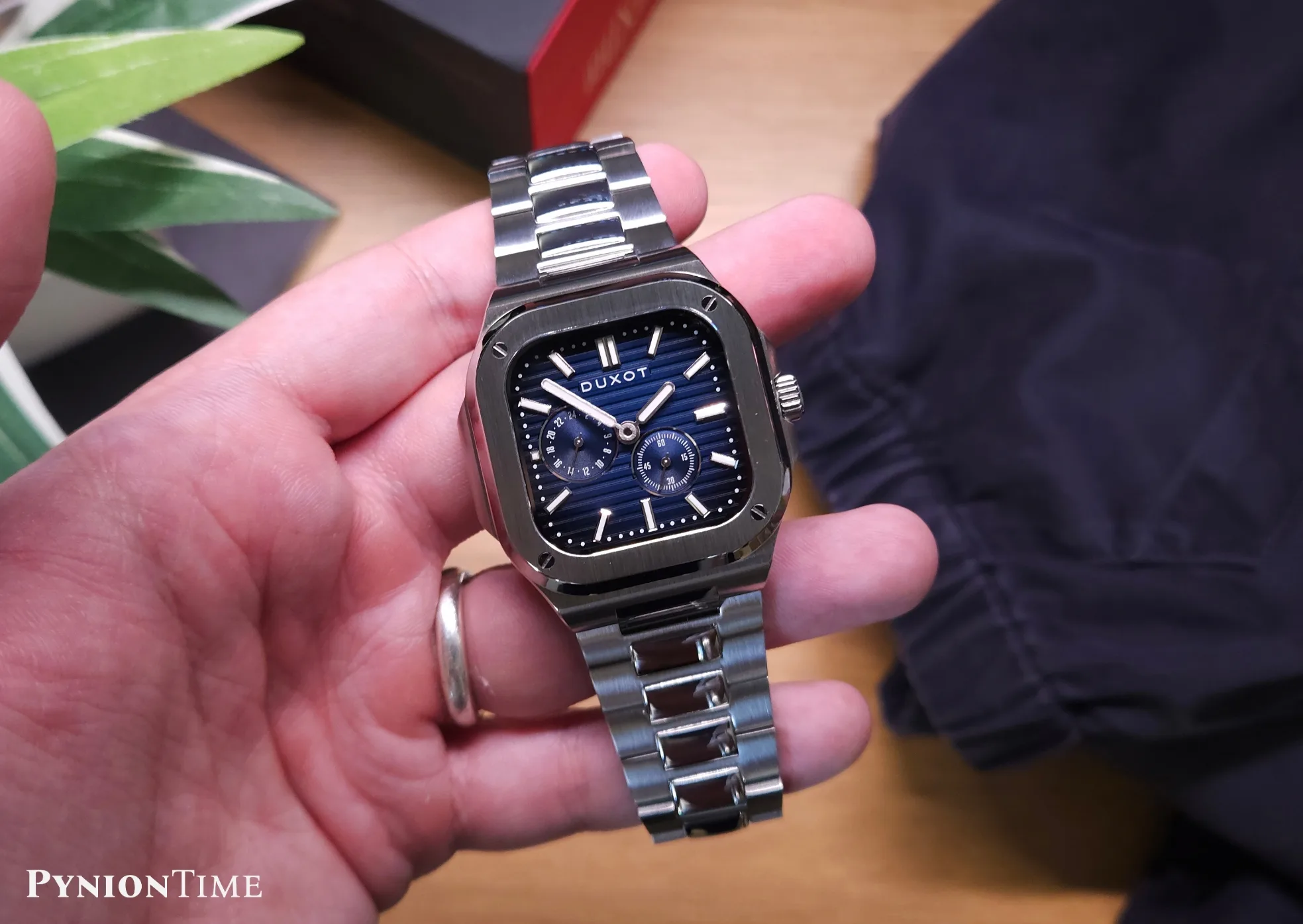
The Cubitus Resemblance Is Obvious, and I Am Grateful for It
Patek Philippe launched the Cubitus in 2024. Patek describes its case as a square bezel with rounded corners, a shape that sits somewhere between a square and an octagon, with vertical brushing, polished bevels, and a horizontally embossed dial. The steel 5821/1A launched at CHF 35,000.
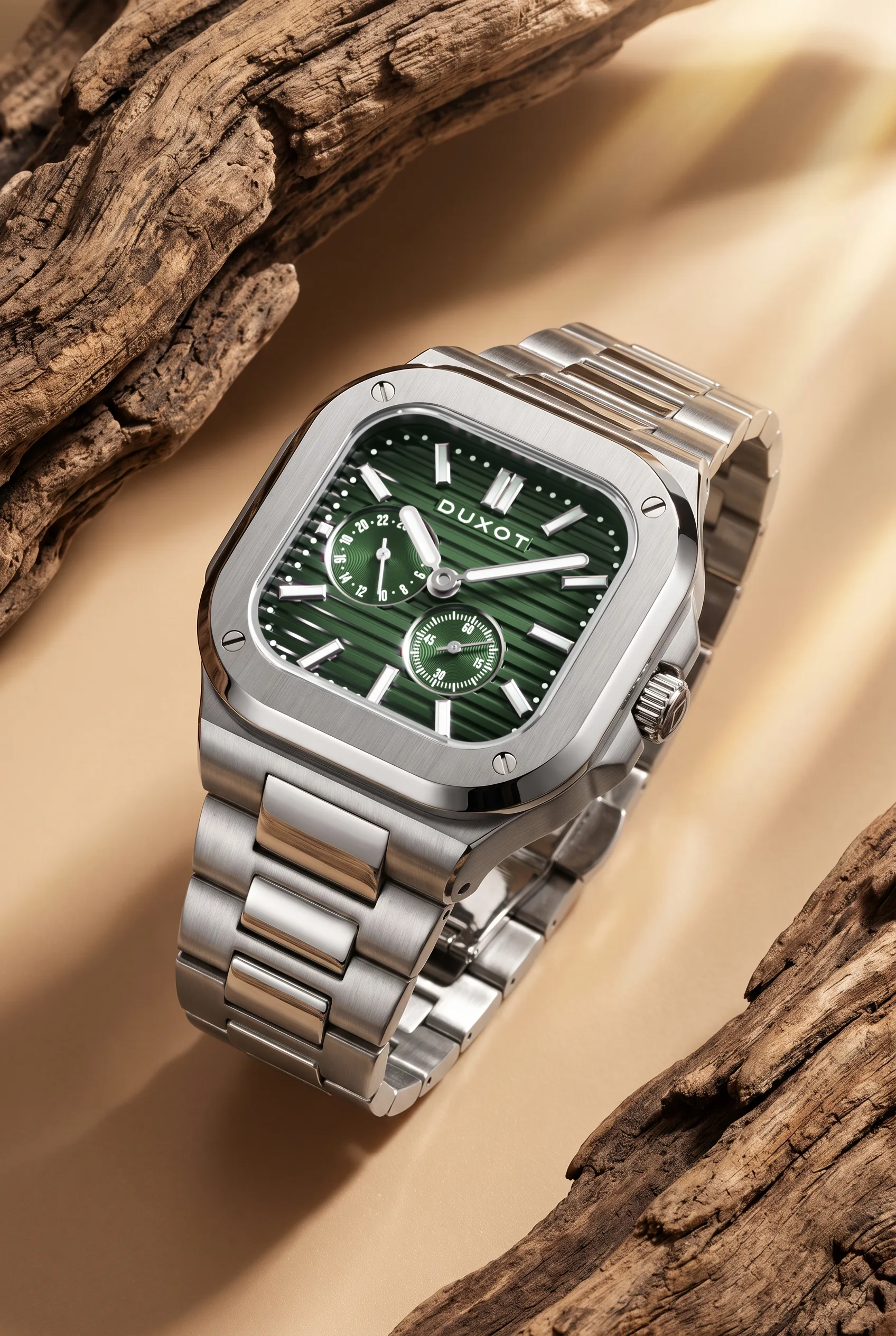
Put the Quadrata next to it and the family resemblance is impossible to miss. The squared case with softened corners, the brushed surfaces cut by polished edges, the horizontal lines across the dial, the bracelet flowing straight out of the case: it is all there. I love that case shape. It is one of my favorite designs of the last few years, and it was never going to be within reach for most of us.
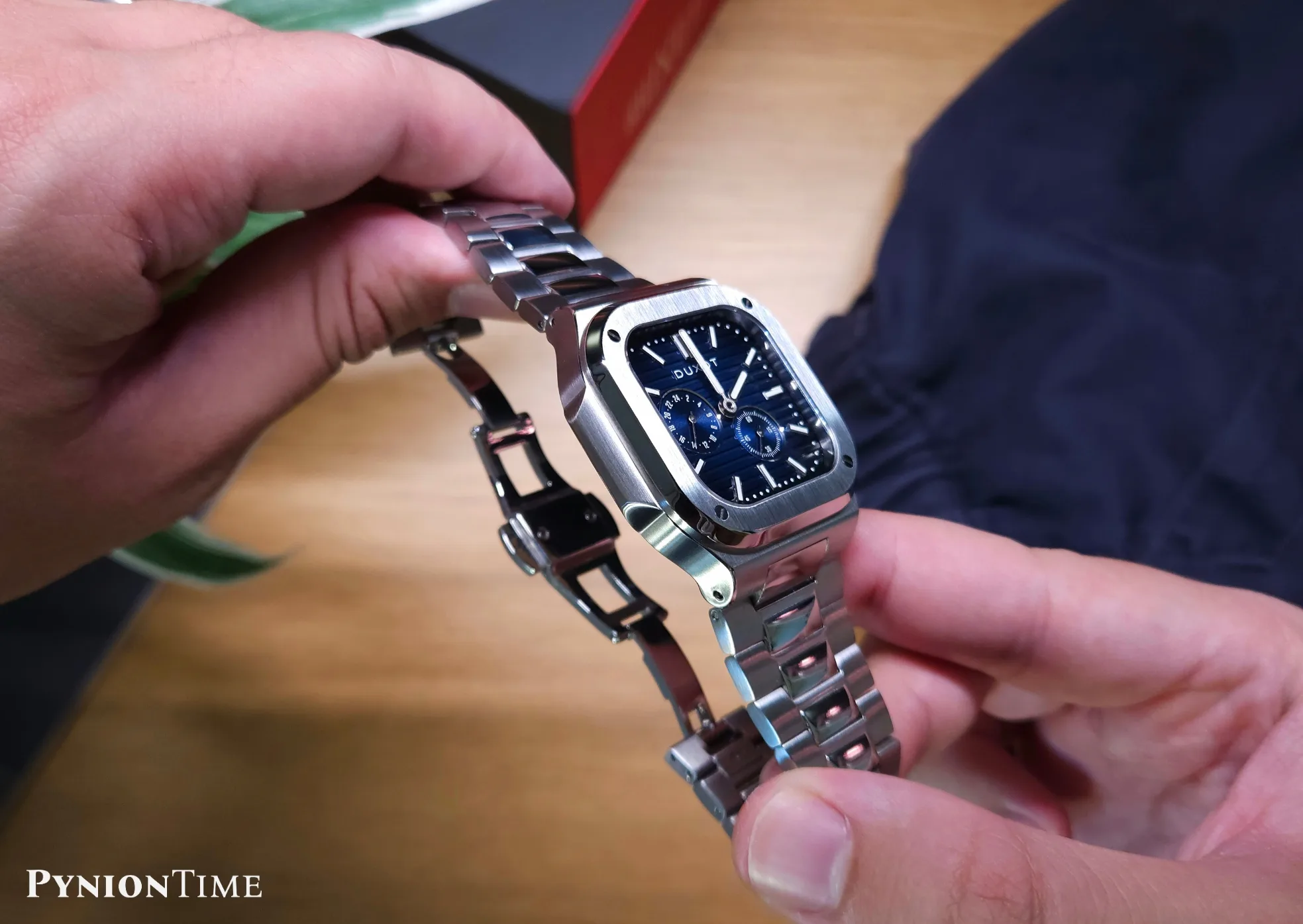
That is why I am grateful Duxot did this. It puts a design language that belonged to one of the most expensive watchmakers in the world within reach of almost anyone who likes watches, and it does it with care rather than as a cheap shortcut. This is exactly what the best affordable alternatives to iconic watches should do.
It is not a copy, though. The exposed screws on the bezel, the fumée gradient, and the 24-hour and small seconds layout are Duxot’s own, and they give the Quadrata a slightly more technical look than the Patek. At 42mm it is also smaller than the 45mm Cubitus, which suits my wrist better anyway.
42mm on Paper, Much Smaller on the Wrist
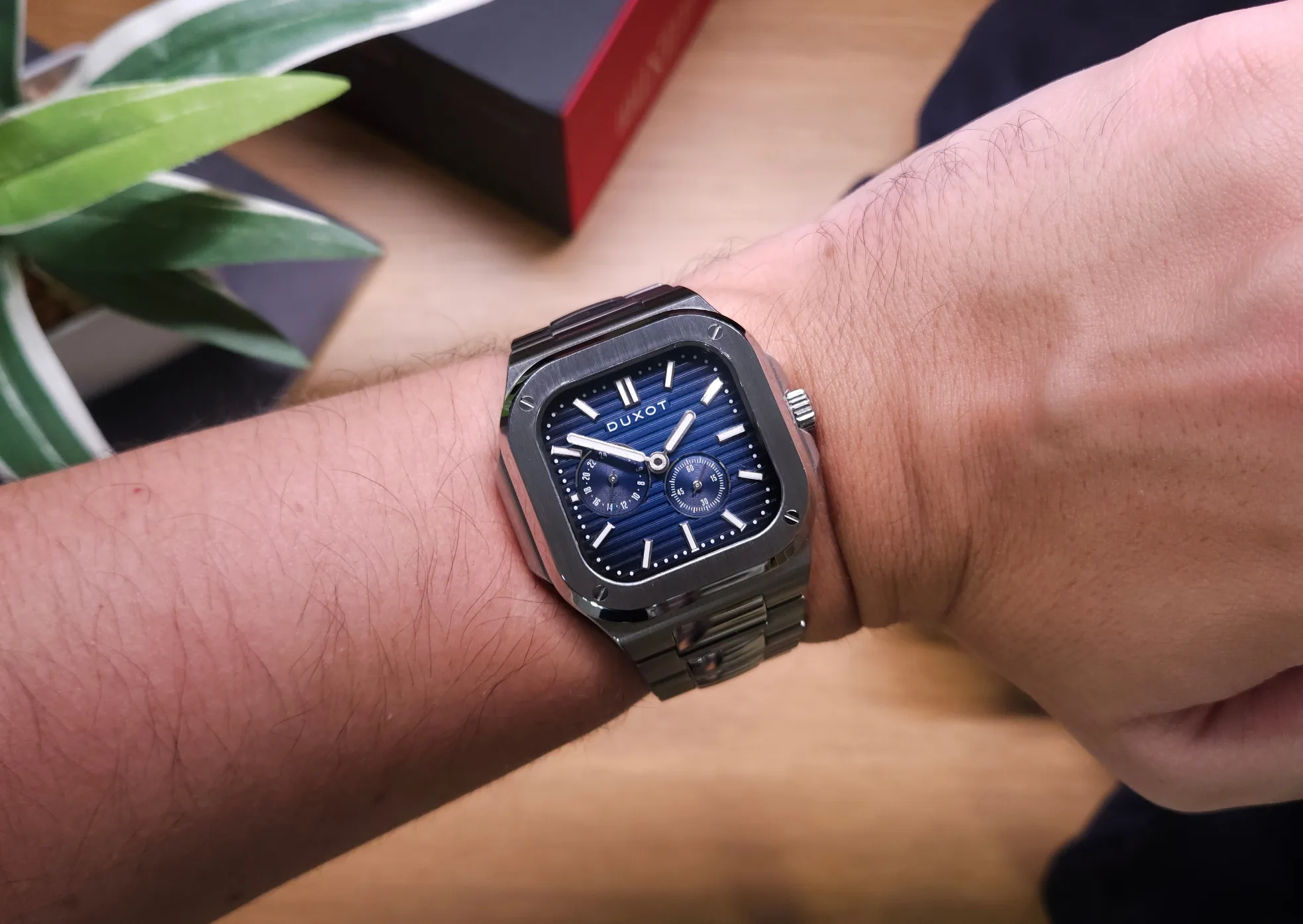
My wrist measures 6.5 inches, and 42mm is usually where I start getting nervous. On a round diver, that number means a watch that sits wide and tall. The Quadrata does not wear like that at all.
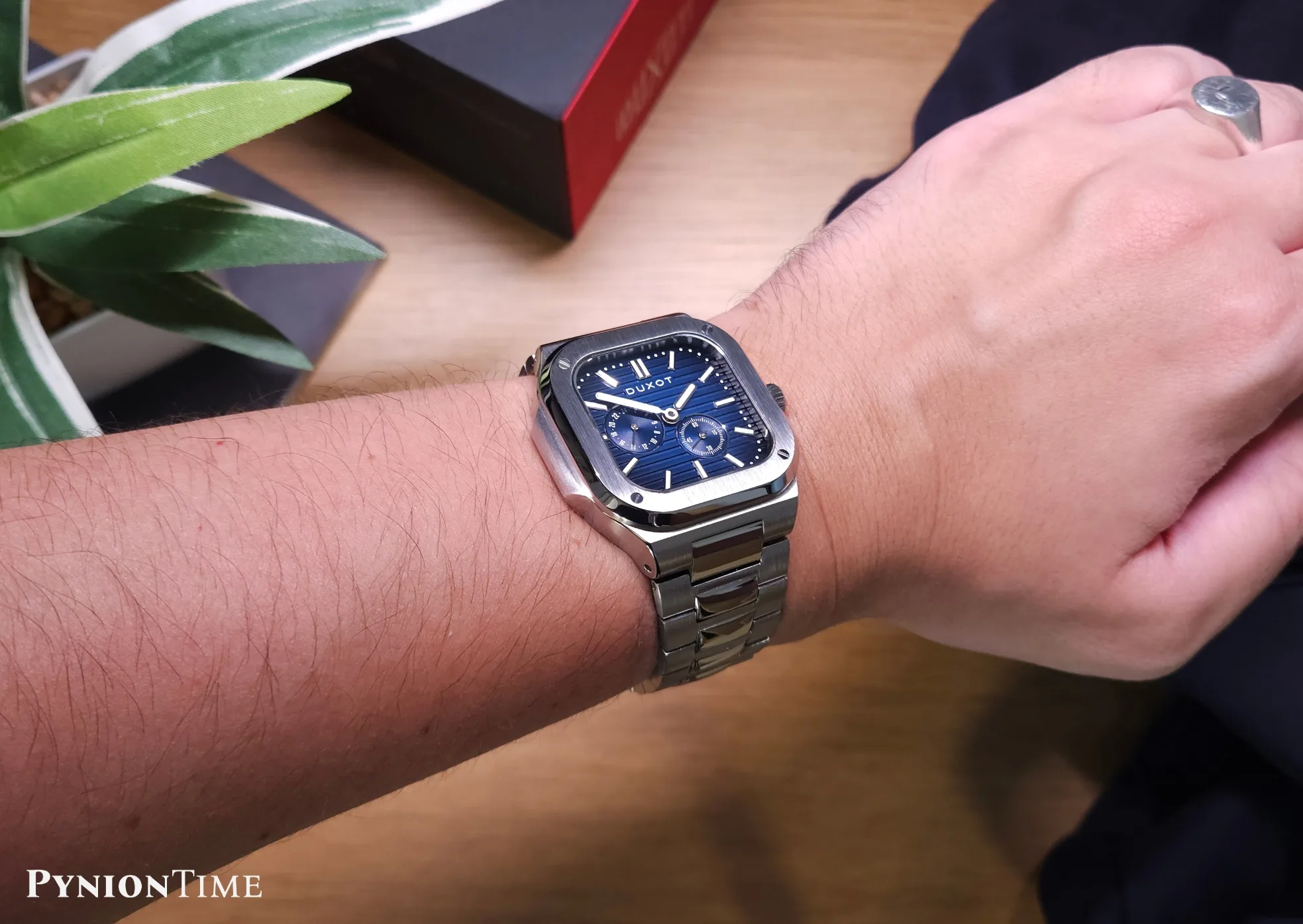
The reason is the other two numbers. The lug-to-lug is only 46mm and the case is 11.4mm thick, so nothing overhangs and nothing sits high on the wrist. The square shape also puts the width into the corners rather than into a big round footprint. This watch is the clearest example I have handled of why diameter alone tells you very little. If you have a smaller wrist and 42mm scares you off, I would still look at the lug-to-lug before crossing it off your list.
Finishing This Good Should Not Cost $320
This is where the Quadrata surprised me most, and where most of the value sits. The brushing is fine and even, the polished surfaces are close to a mirror, and the transitions between the two are clean. At this price I expect at least one of those to be a bit rough. None of them are.
That matters more here than on most watches. A Cubitus-style case lives or dies on the contrast between brushed faces and polished bevels, and if that contrast is sloppy, the whole design looks cheap. Duxot got the finishing right, and that is what makes the resemblance work.
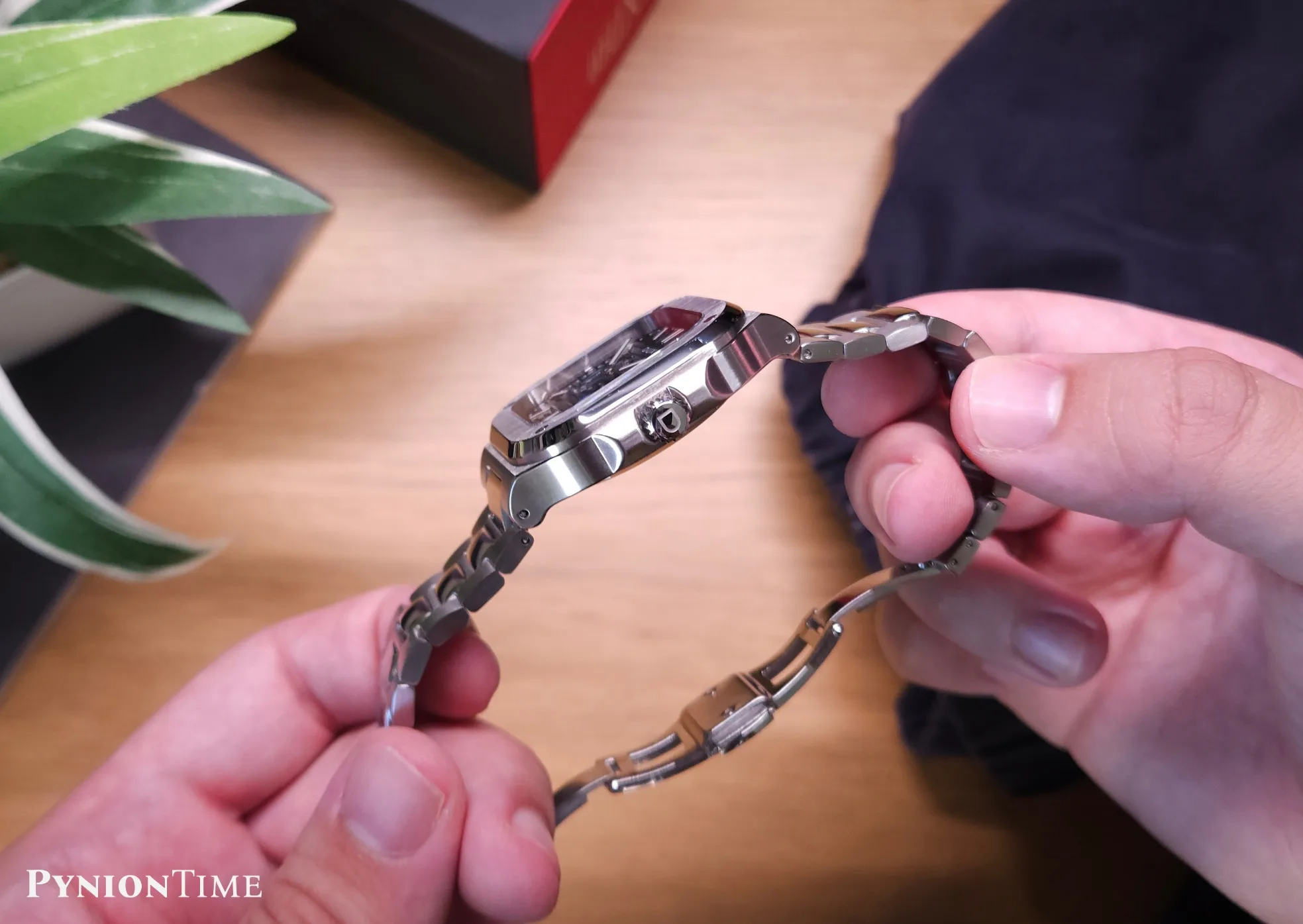
The bezel screws look good too. If you look closely, a couple of them sit ever so slightly off center. You will not notice it at a glance, and it is not a budget-only problem: I have seen the same thing on pieces that cost considerably more such as the Nivada F77. I would not let it put you off.
The crown is a simple pull-out design with the Duxot “D” debossed on the end. It does its job, and on a watch rated to 5 ATM that is all I need from it.
The Fumée Dial Makes the Case for the Whole Watch
The Aqua Luxe’s blue dial looks almost plain in dim light. Tilt it toward a window and the fumée appears, darkening toward the edges, while a fine horizontal line pattern runs across the surface. That grain is the most elegant detail on the watch, and it is the thing I kept looking at over dinner.
The layout is asymmetric, and I like it more for that. The 24-hour subdial sits at 9 o’clock and the small seconds at roughly half past four, which leaves the right side of the dial more open than the left and keeps it from looking like a generic chronograph.
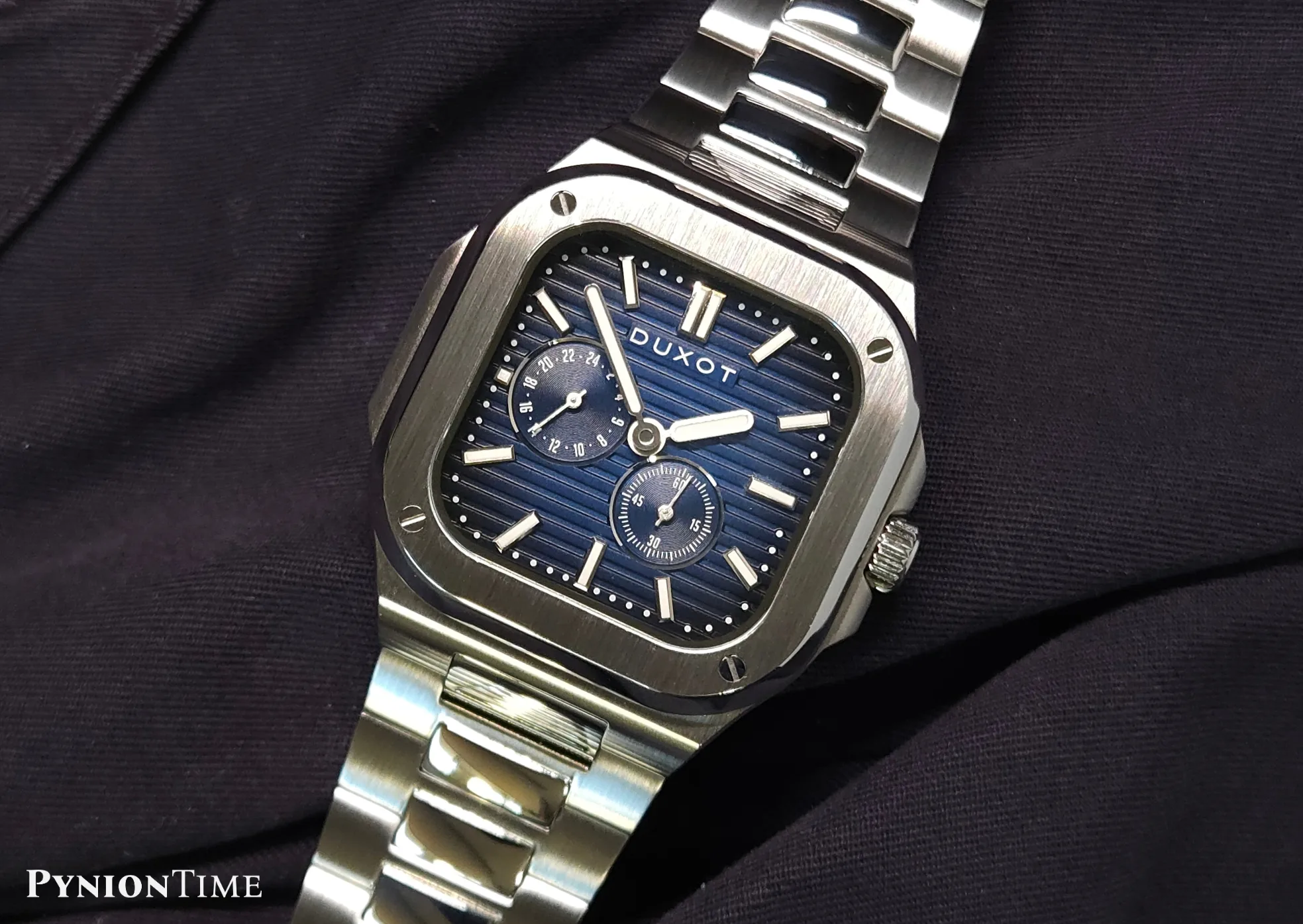
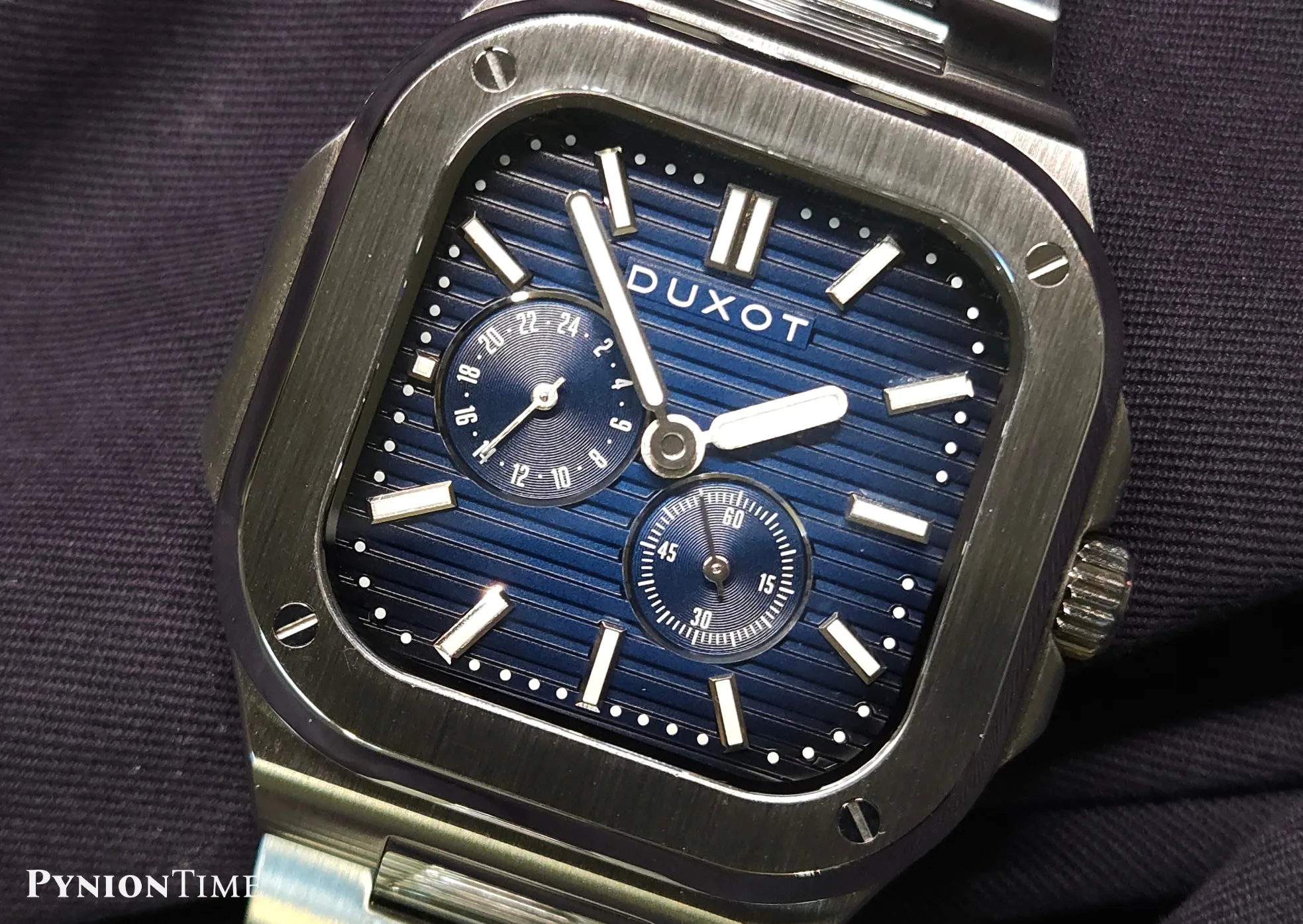
The markers and hands are what sell the illusion, though. Their quality is excellent, and they are a big part of why this watch feels like something from the four-figure bracket when you look at it closely.
The 24-hour register is easy to read, but be realistic about its role. You are not going to use it as a tool the way pilots use the 24-hour hand on AVI-8’s Spitfire 24 Hour. Here it is decoration that happens to work, and it gives the dial more depth than a plain three-hander would. The lume is weak. I did not miss it, because this is not a watch you check in the dark.
The dial is also immaculate. Dust specks on the dial are not unusual at this price, but I could not find a single one.
The Movement Is Where Duxot Saved Money
Inside is the Miyota 8247, a 21-jewel automatic from the same family as the 8215, with the 24-hour hand and small seconds built into the caliber. You will not see that number through the screw-down exhibition caseback, though: the rotor is decorated with Duxot branding.
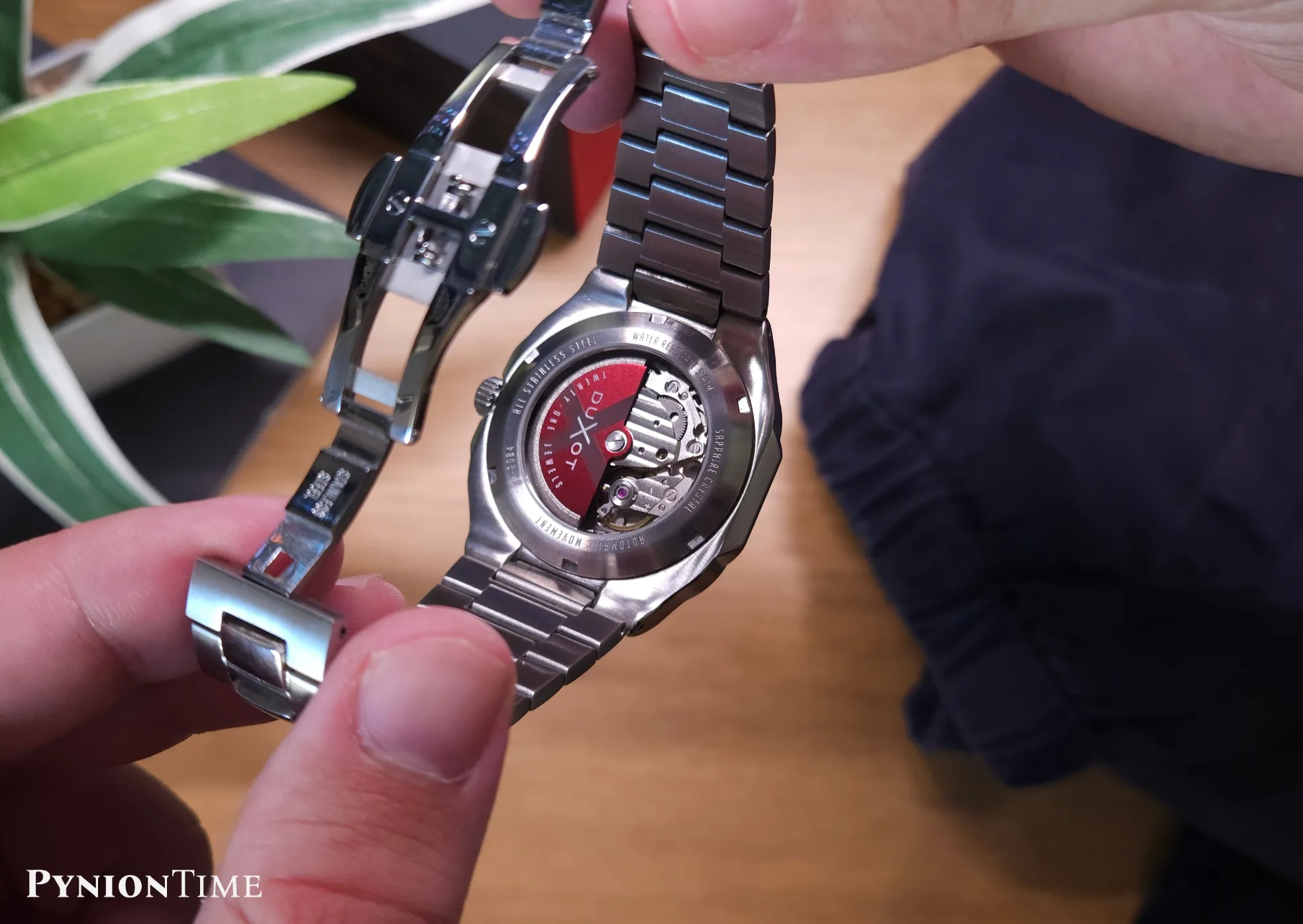
What I can tell you is how it behaved. Over my time with it, it ran at around 20 seconds a day, give or take, which sits within Miyota’s official tolerance of -20 to +40 seconds a day. It winds by hand, which I appreciate on a watch I do not wear every single day, but it does not hack, so the seconds hand keeps running while you set the time.
In practical terms, the 8247 has a power reserve of around 40 hours and beats at 21,600 vibrations per hour. That means two things for daily life. If you take it off on Friday evening, it will have stopped by Sunday, so on Monday you give it a few turns of the crown and set the time. And the small seconds hand, being so short, actually looks smoother than a low-beat movement would suggest, since each tick covers only a tiny distance.
None of this is a deal breaker for me. It is simply the part of the watch that feels its price, and how affordable mechanical movements are built explains why brands at this level usually make that trade. Duxot spent the money on the case, dial, and bracelet, which is what you see and feel every day.
A Bracelet You Forget You Are Wearing
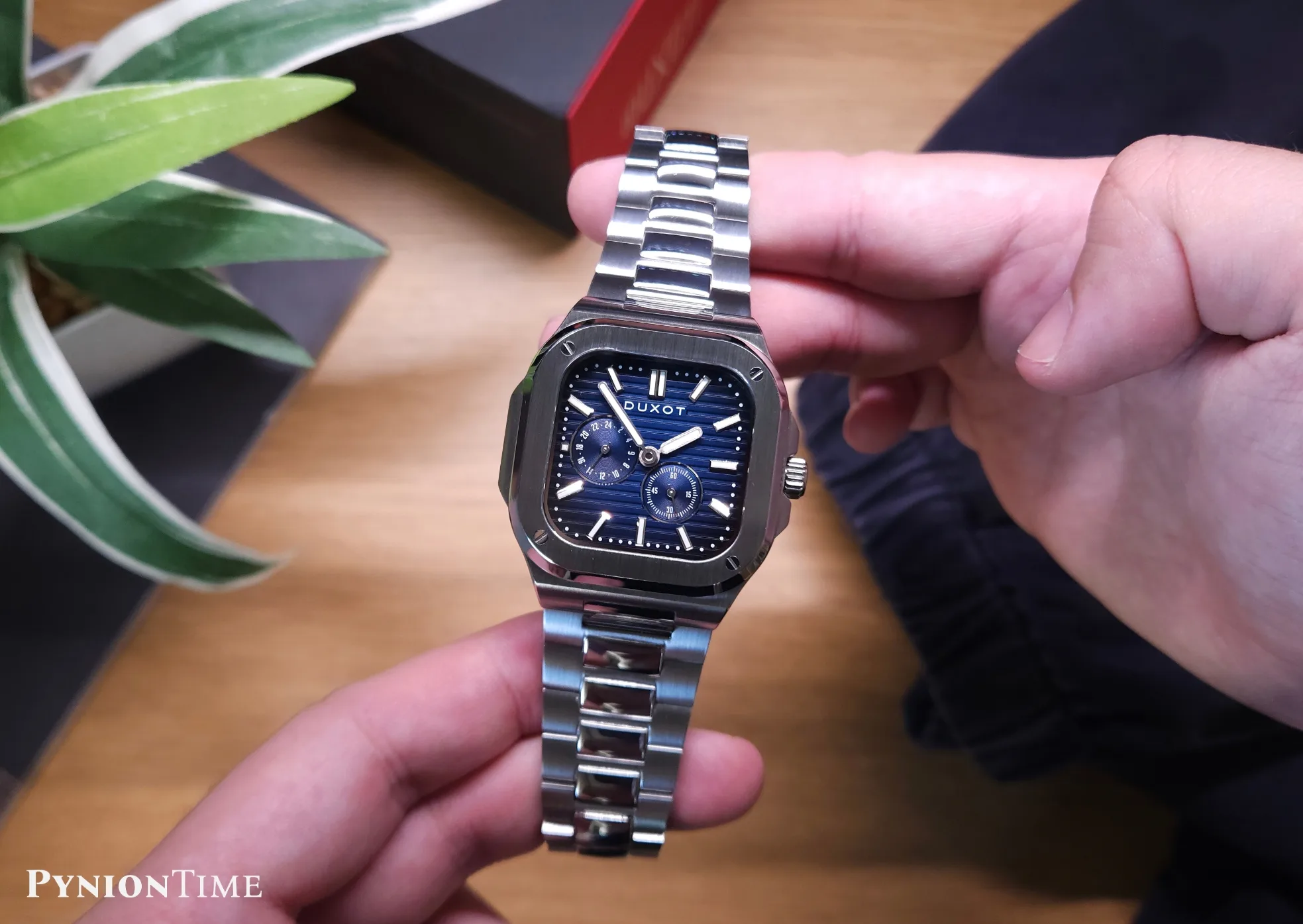
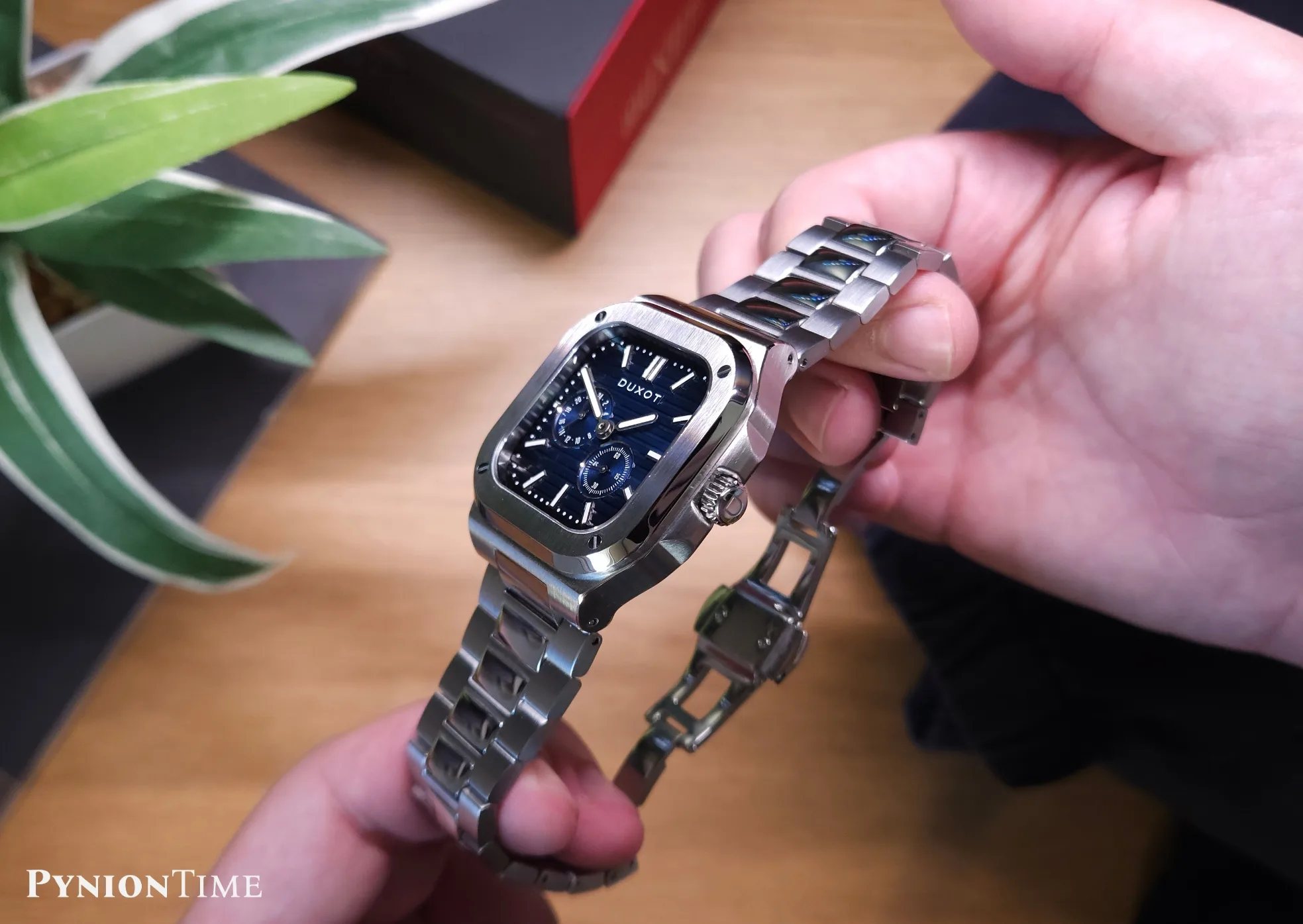
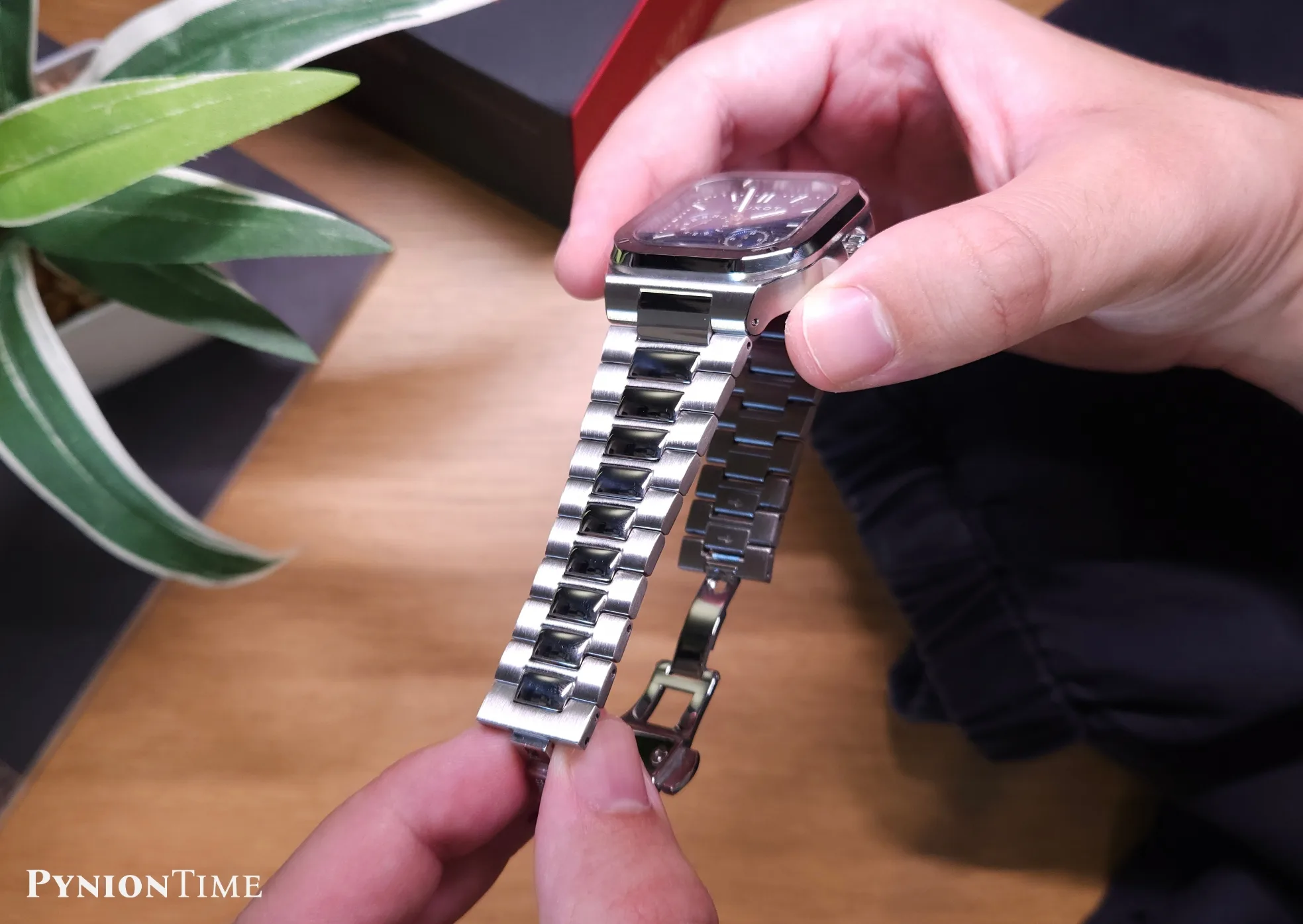
The integrated bracelet tapers from 25mm at the case to 17mm at the clasp. That is a dramatic drop, and on the wrist you can see it and feel it. It is also the main reason this watch looks so well proportioned on a 6.5-inch wrist.
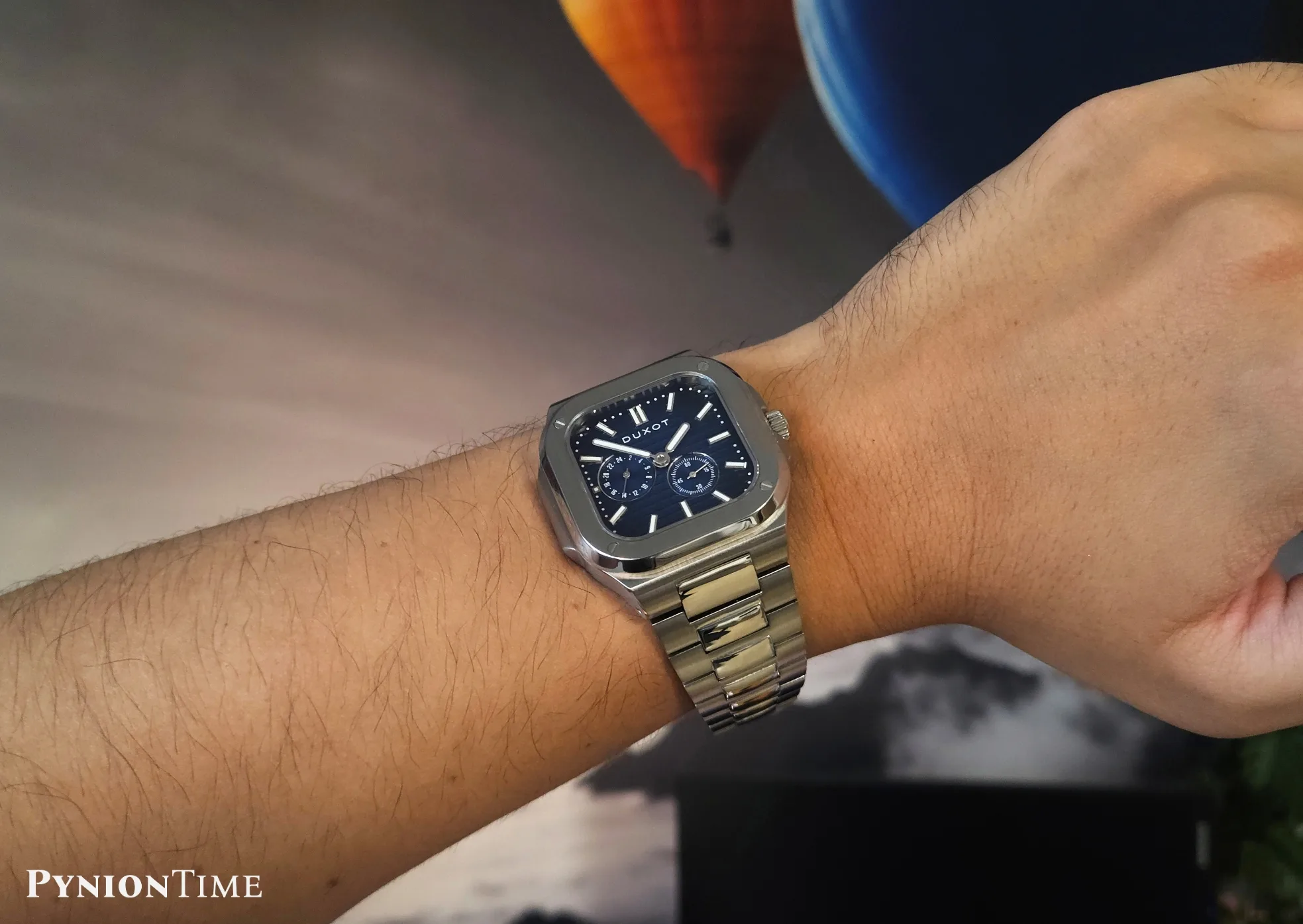
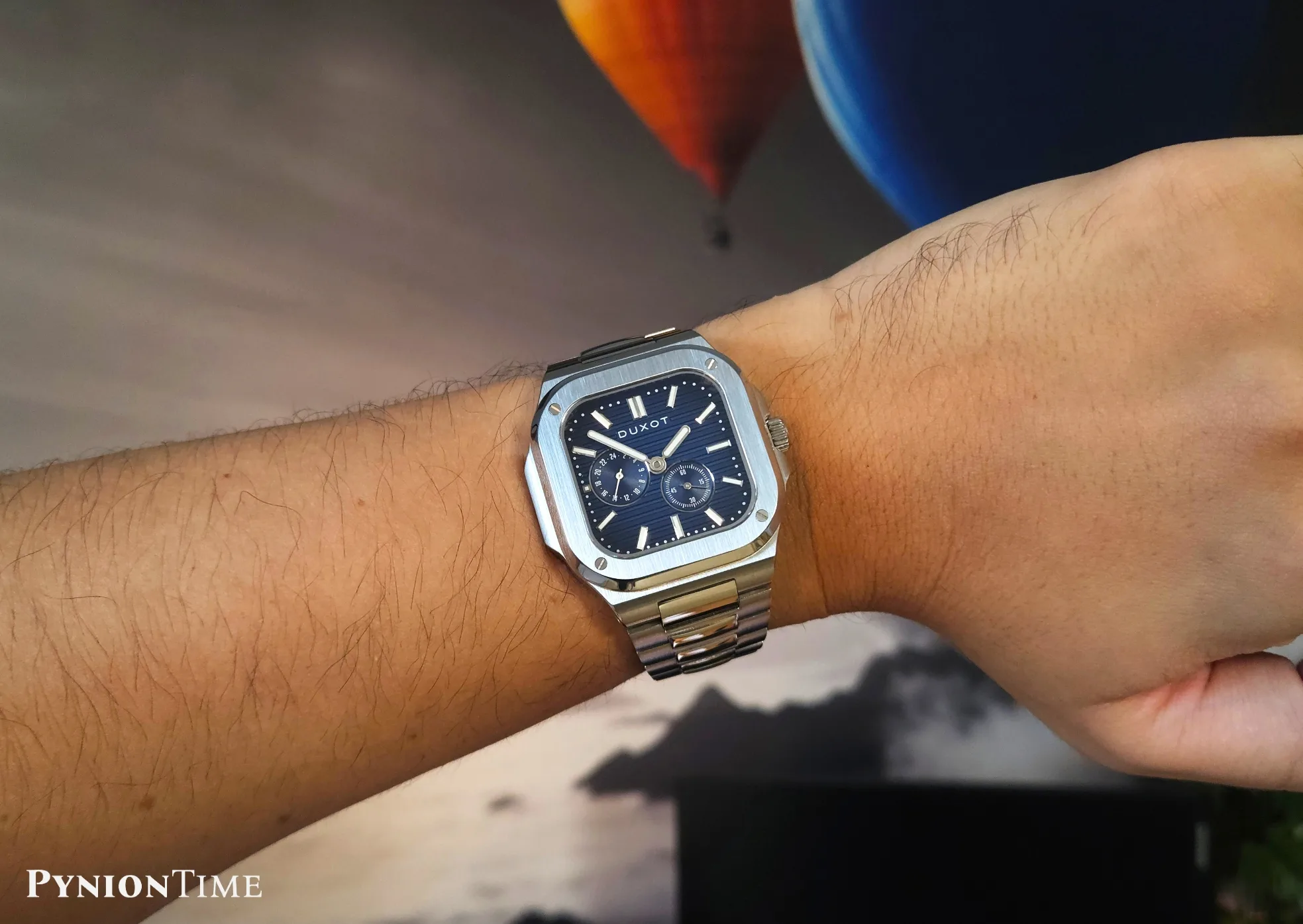
It is very comfortable. After an hour I stop registering that it is there. The links are well made and flex easily, so it follows the wrist instead of sitting on it like a plank. Sizing it was easy, and the push-button butterfly clasp works exactly as it should, with no fuss. I did not try it on a strap, and I see no reason to.
That taper is also the clearest improvement over the Taranto. The Taranto’s proportions were already close to ideal for me at 37mm, but its bracelet runs straighter and looks more uniform on the wrist. The Quadrata’s steeper taper gives it a more tailored silhouette, and its dial and markers look a step above. The Taranto remains the better choice if you want a round case and a date. For me, the Quadrata is the more convincing watch for about the same money.
Four Versions, and the Steel Ones Are the Smart Buy
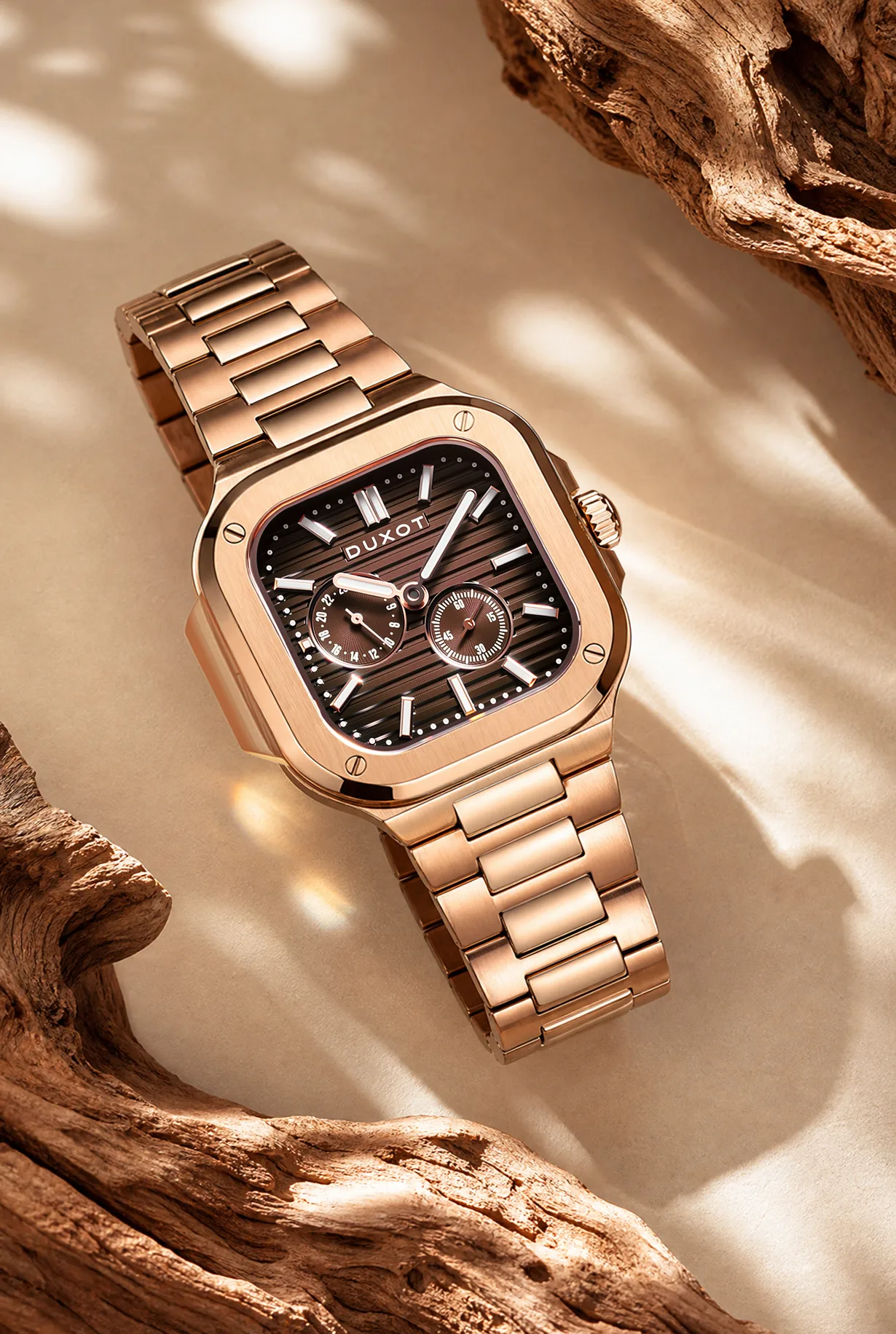
Duxot is launching the Quadrata 24 Hour in four versions, and they split neatly into two price points. The two all-steel models cost $320: the Slate Fusion with a dark dial and the Aqua Luxe with the blue dial I wore. Above them sit two rose gold-tone versions. The Blue Enigma pairs a blue dial with a two-tone case and bracelet for $350, and the Toffee Touch goes fully rose gold-tone with a brown dial for $360.
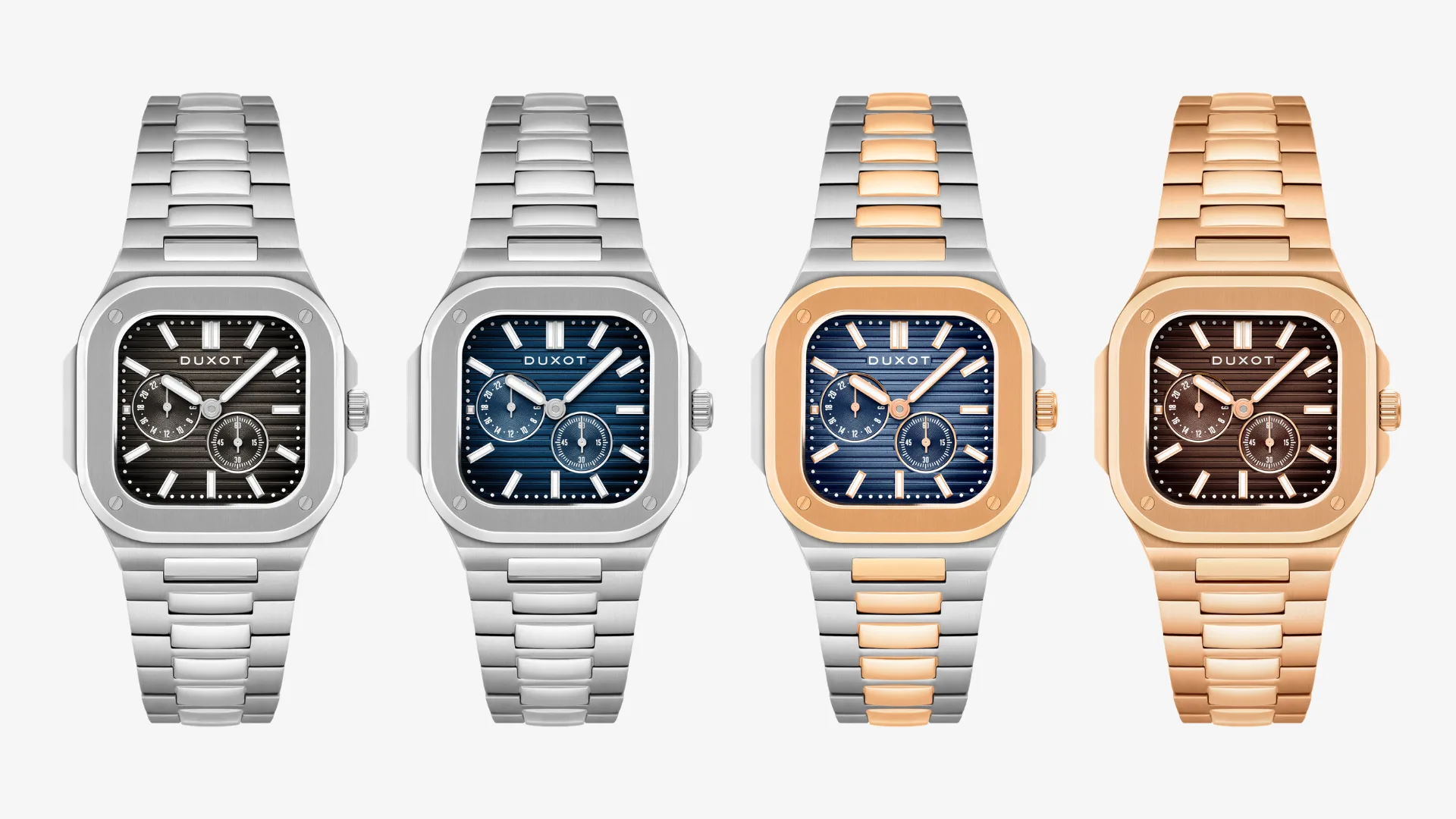
The Blue Enigma is the one Cubitus fans will spot first, because Patek also makes a steel and rose gold Cubitus, the 5821/1AR, with a blue dial. I have only worn the Aqua Luxe, so I cannot tell you how the rose gold-tone finish looks in person or how well it holds up. What I can say is that plain steel is what makes this design look expensive to me, and it is also the cheapest way in. If you want the most watch for the money, start with the two $320 models.
The whole collection is available from September 25, 2026, directly from Duxot.
It Collects Fingerprints, Not Scratches
After wearing it this much, the polished surfaces are the only part that asks for attention. They pick up fingerprints constantly, so expect to wipe it down often if that bothers you. There are no scratches yet, though, which I did not take for granted on a watch with this much polish.
At 11.4mm thick, it also fits under a shirt cuff, which matters on a watch I keep reaching for on office days. And it gets noticed. Friends loved it when I wore it to dinners, and the word they used was premium. That is exactly the effect a $320 watch with this design should be going for.
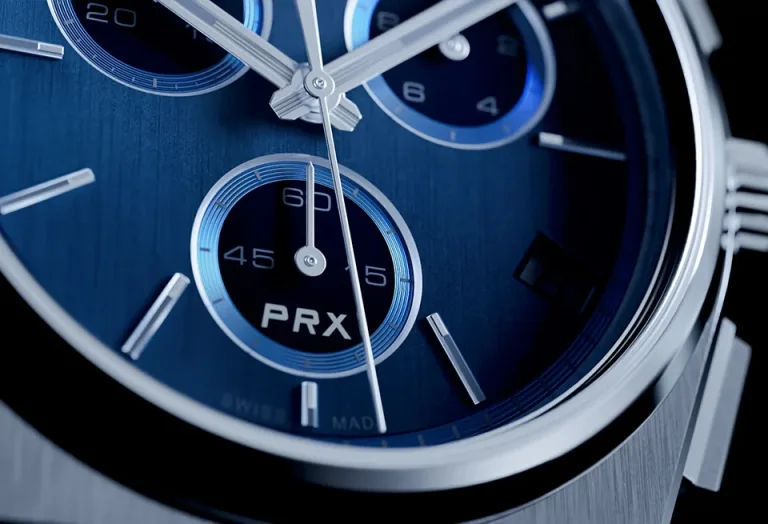
Integrated bracelets have become one of the busiest corners of the market, and most of the affordable options lean round. The Tissot PRX is the obvious reference, and its automatic version asks noticeably more than this Duxot. Microbrands like Farer have also moved into the format with the Farer Integra’s more sporty approach, in a much higher price bracket.
The Quadrata’s advantage is that it does not look like any of them. Very few affordable watches take the square Cubitus route, and even fewer pair it with a fumée dial and a 24-hour register at just $320.
Specs, Pricing & Availability
Case Diameter: 42mm
Case Thickness: 11.4mm
Case Material: Stainless steel
Water Resistance: 5 ATM
Caliber: Miyota 8247 Automatic
Crystal: Flat sapphire with anti-reflective coating
Function: Hours, minutes, small seconds, 24-hour indicator
Bracelet: Integrated stainless steel, 25mm to 17mm, push-button butterfly clasp
Price: $320 to $360
Verdict
After the Taranto I thought Duxot had found its formula. The Quadrata 24 Hour is the better execution of it: sharper finishing, a better dial, and the Cubitus look brought down to a price almost anyone can reach. The movement is the weak point, and it is also the part that matters least on a watch like this. It is the one I am wearing to the wedding.
- Cubitus-inspired design at a tiny fraction of the price
- Wears far smaller thanks to the 46mm lug-to-lug and 11.4mm thickness
- Fine brushing and mirror polishing with clean transitions
- Fumée dial with a line pattern that rewards good light
- Markers and hands of excellent quality
- Around 20 seconds a day accuracy, and no hacking
- Weak lume
- No date
- Polished mid-links are fingerprint magnets
Buy it if you want one watch that can go from the office to a wedding without looking out of place. It also makes sense if you have a smaller wrist and have written off 42mm watches, or if you care most about finishing, dial quality, and comfort, and you are happy to accept an ordinary movement for them.
Skip it if you need a date, since there is none. The same goes if you want a watch you can take swimming without thinking (5 ATM and a pull-out crown are not dive specs), if you expect usable lume, or if you plan to set the time to the second: without hacking, that is fiddly.
Worth It at $320 to $360?
Yes, and without much hesitation. This is one of the strongest value propositions I have reviewed this year. You get a design that references one of the most desirable watches of the decade, case finishing that holds up to close inspection, a dial that looks four-figure, and a bracelet I forget I am wearing. The corners where Duxot cut costs, mainly the movement and the lume, are ones you rarely notice day to day. And the steel Aqua Luxe I wore is the cheapest way into the collection, which makes the value argument even stronger.