PÉGOUD Onduleur Automatic: A New Pilot Brand Arrives With Six Dials at $280

PÉGOUD is not a name you have seen on a wrist. It is a new marque built on a single idea, the wristwatch as an instrument for the sky, and it makes pilot’s watches in the spirit of an age when a watch was flying kit rather than an accessory. That premise is not rare. What is rare is a brand arriving with six references at once and no back catalogue to hide behind.
The Onduleur Automatic is that arrival. It is a six-dial mechanical collection built around a fixed, undulating coin-edge bezel and a twin-crown layout that drives an internal rotating ring for a second time zone. It is aimed at someone who wants an aviation watch with an original face rather than another Type B homage, and who is buying at the sharp end of the budget.
A first collection at this money has to be recognisable within a second, and the case and bezel is where PÉGOUD has spent most of its design budget.
The Brand Is New, the Name Is Not
Most aviation watch brands reach for an aircraft. PÉGOUD reaches for a pilot, and a specific one. Adolphe Pégoud (1889-1915) was a French aviator and test pilot for Louis Blériot who, on 1 September 1913, became the first pilot to fly inverted. In the months around that flight he helped invent aerobatics as a discipline, pioneering intentional inverted flight and the side-slip, and drawing enormous crowds across Europe as one of the world’s first display pilots.

Then the war came and he did it again. After downing five enemy aircraft, French newspapers called him l’as, the ace, making Pégoud the world’s first fighter ace. He died in combat in 1915, at 26.
That history is not decoration here. Onduleur means the undulating one, and the wavy coin-edge bezel is meant to read as those early flight paths. It is the kind of literal design idea that either lands or embarrasses itself, and this one lands, because it is a shape you can identify across a room. For a brand with no recognition to trade on, that is the whole job of a first collection.
Twin Crowns, But Read the Fine Print
The second crown, capped with a triangular index, rotates an internal ring for an at-a-glance second-time-zone reference. This is a compressor-style layout borrowed from dive watches and repurposed for travel, and it works well enough for what it is.
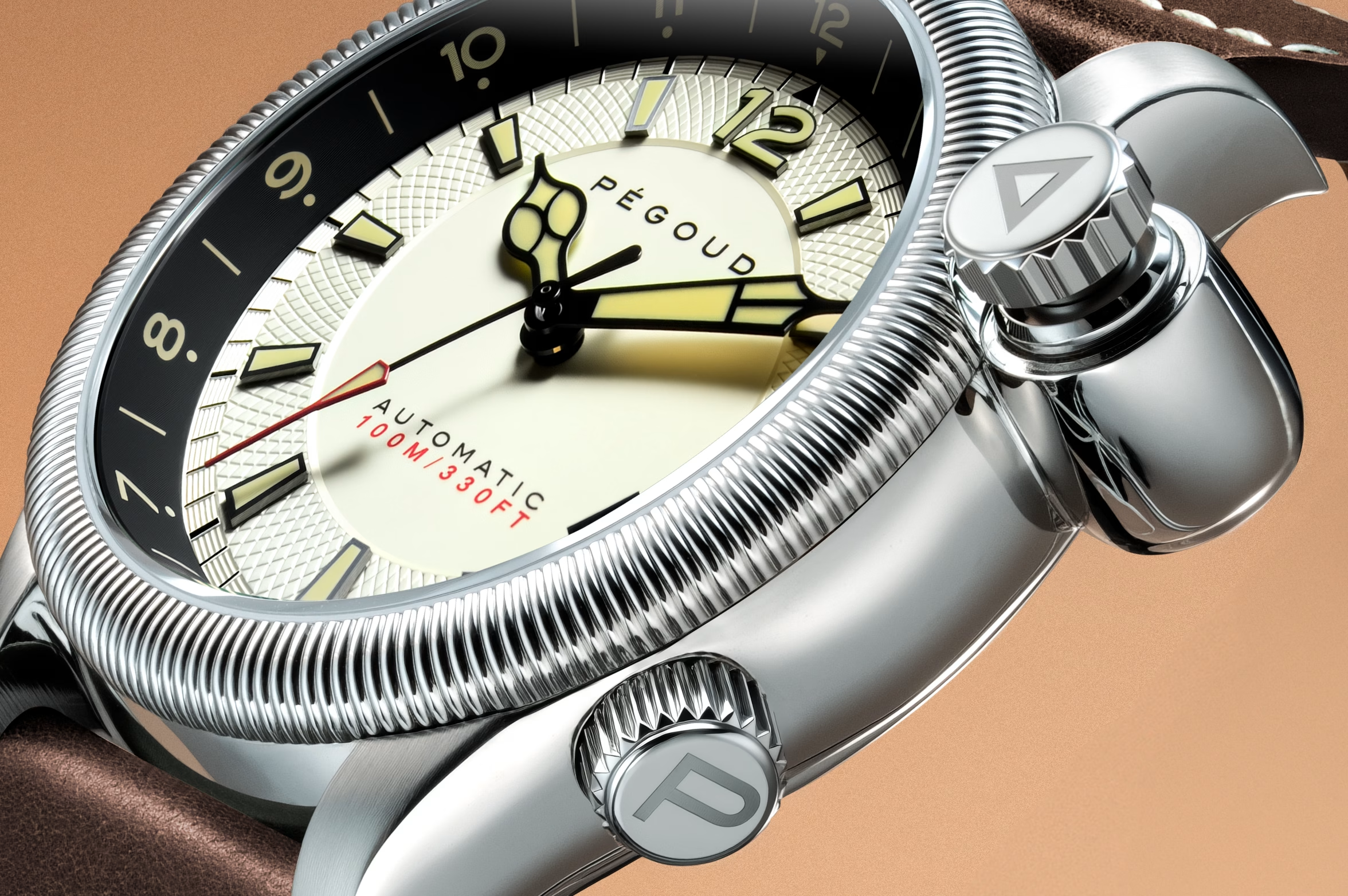
It is not a GMT. There is no independent hour hand and no fourth hand tracking a second zone on its own, so the reference is manual and approximate: you set the ring, you read the offset. Buyers who want an actual travel complication at this money should compare it against something like a caliber-driven approach to a second time zone before deciding. What the inner ring buys instead is a dial that stays clean and a crown at the flank that looks purposeful rather than decorative.

Inside is a self-winding Japanese Miyota 8215 automatic with three hands and a date. The 8215 is one of the most widely used automatics in affordable watchmaking and it has a well-documented character: 21,600 vph, roughly 42 hours of power reserve.
The Lume Scheme Is the Smartest Thing on the Dial
Under a single-curve anti-reflective sapphire crystal, applied indexes and sword hands carry a two-tone luminous treatment: blue across the hands, green along the markers. Splitting the colours is not a styling choice. It keeps the hands separable from the markers in the dark, which is the one thing a pilot dial has to get right at three in the morning.


Most watches at this money use a single lume colour on everything and leave you to work out which glowing shape is the minute hand. Doing it in two tones costs more, and it is the detail that will make these photograph well and read well.
The rest of the dial furniture is deliberately conventional: applied indexes, sword hands, a date, nothing fighting for attention. That restraint matters because the case is not restrained. Forty-three millimetres of faceted stainless steel in vertical-brushed and polished surfaces, wrapped in a fixed coin-edge bezel with no timer scale and no countdown track, is already doing plenty of talking.
Six Dials That Are Actually Six Different Watches
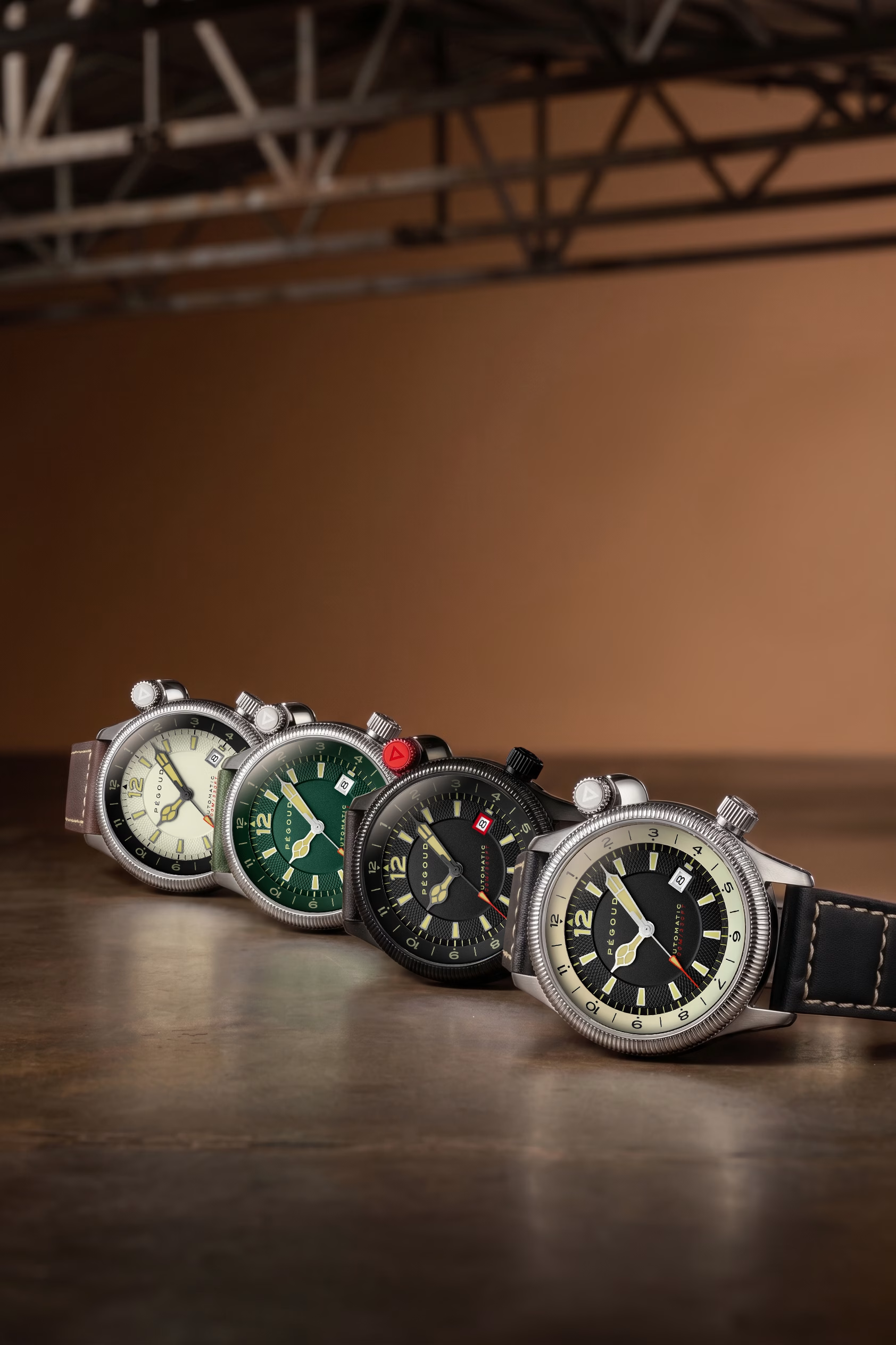
The launch spans HARVEST (PG-9008-01), VINTAGE GREEN (-02), BLACK (-04), COMBAT IVORY (-05), AERO NOIR (-06) and HORIZON BLUE (-07). The naming does most of the positioning work, and the spread is wider than the usual black-blue-green trio: COMBAT IVORY and HARVEST push toward the vintage military end, HORIZON BLUE and AERO NOIR toward the modern instrument end.

Only BLACK carries a price bump, to $300, for its black-IP treatment. That is a fair premium and it is the variant most likely to sell out first, because black-coated cases photograph well and this one has a coin-edge bezel to catch light on.
Finishing details are consistent across the line: a crown debossed with the PÉGOUD “P,” a solid screw-down caseback carrying the marque’s infinity motif, and a 22mm genuine leather strap with contrast ivory stitching and a logo-etched buckle. Water resistance is 10 ATM, which is more than a pilot watch needs and exactly enough to stop anyone worrying.
43mm and 14.9mm Is the Real Objection
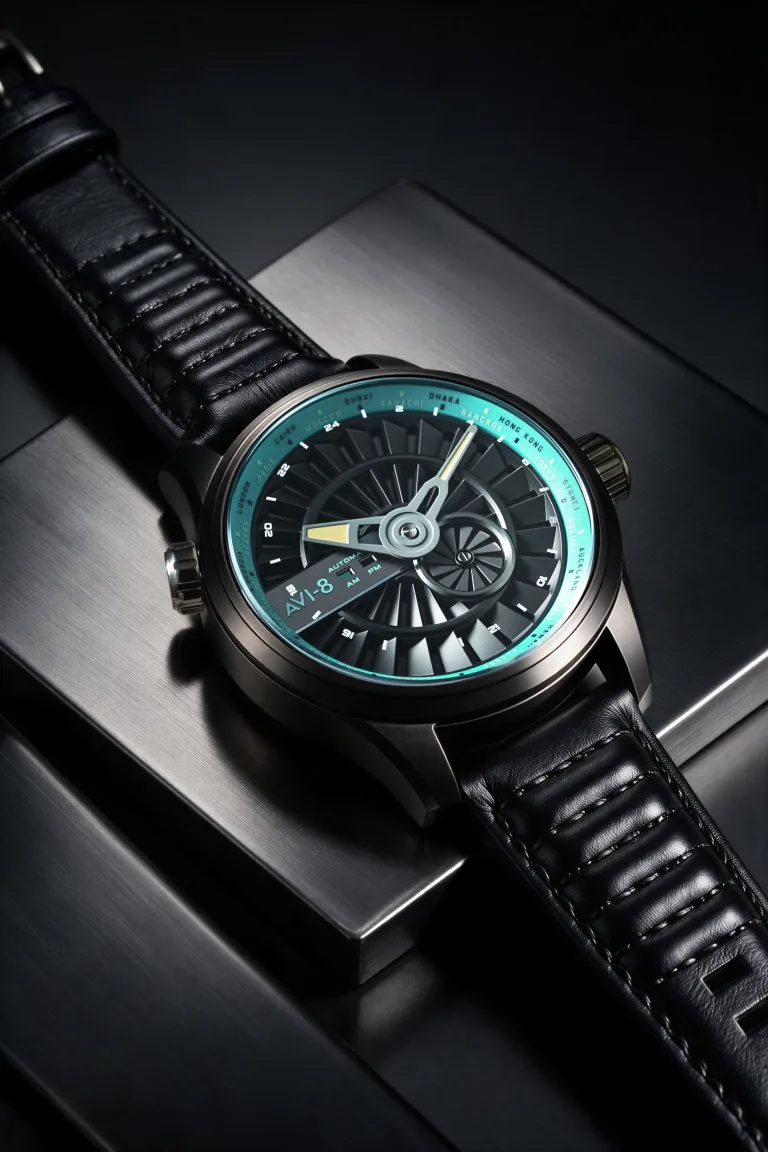
Here is the friction. The case is 43mm across and 14.9mm thick, and that is a lot of watch in 2026, when the affordable segment has spent three years shrinking. Brands with real aviation credibility, including the museum-partnered AVI-8 field and pilot releases, have been trimming diameters for exactly this reason.


Some of that thickness is structural. An internal rotating ring needs vertical space, and the 8215 is not a thin caliber. But the brand has not published a lug-to-lug figure, and on a 43mm faceted case with a fixed bezel that number decides whether this works on a 17cm wrist or hangs off it. Anyone under about 18cm should wait for real wrist shots before ordering.
Specs, Pricing & Availability
Case Diameter: 43mm
Case Thickness: 14.9mm
Case Material: Stainless Steel
Water Resistance: 10 ATM
Caliber: Miyota 8215, Japanese automatic with 3 hands and date
Crystal: Anti-reflective coated sapphire, single curve
Function: Hours, minutes, seconds, date, internal rotating second-time-zone ring
Price: USD 280 (USD 300 for PG-9008-04 BLACK)
My Verdict
I like this more than I expected to. At $280 the Onduleur is not competing on movement and it knows it, so it competes on a case and bezel profile nobody else is using and on a namesake with a story worth reading. That is a more durable foundation for a new brand than a fourth Type B homage, even if the first year is harder.
Buy it if you want an aviation watch that looks like nothing else on the shelf and you have the wrist for 43mm. Skip it if you thought the second crown meant a true GMT, if 14.9mm of case thickness is a dealbreaker, or if your collection has already moved to 38mm and stayed there. For a brand introducing itself, this is the right kind of risk, and I would rather see PÉGOUD lose a few sales to case size than win them by looking like everyone else.
Check out The Ultimate Affordable Watches Guide