Orient Mako GMT: The Diver Finally Gets a Second Time Zone

Orient has spent the last decade as the answer to a very specific question. Somebody wants a first automatic diver for well under 400 dollars, and the Mako or the Ray comes up before anything else. Somebody wants a dress watch that does not look like a starter watch, and the Bambino does the job. The brand built that reputation on in-house calibers and steady, unglamorous consistency rather than trend-chasing.
What it never did was travel. While Seiko dropped the 4R34 into the 5 Sports line and turned the affordable GMT into a mainstream category, and Miyota’s 9075 gave every microbrand with a Kickstarter page a jumping-hour movement to sell, Orient sat out the whole cycle. The new Mako GMT changes that.
The watch it will be shopped against is obvious. The Seiko 5 Sports GMT has owned this price bracket since 2022, and anyone browsing the affordable GMT shelf this is landing on has already been pointed at an SSK001 more than once. Orient is not sneaking in at the bottom of the segment. It is asking for more money than Seiko, which means it needs a reason.

The 24-Hour Hand Does Not Move Independently
This is the part that decides whether the watch is for you, and Orient states it plainly in its own materials rather than burying it. The new F6P22 caliber drives the 24-hour hand directly off the 12-hour hand. There is no independent adjustment. To read a second time zone you rotate the 120-click unidirectional bezel until the 24-hour scale lines up with the offset you want.
Orient frames this as heritage, and it is accurate history: the earliest GMT wristwatches of the 1950s worked exactly this way, before the independently settable fourth hand became standard. It also has real consequences. Offsets that are not whole hours are awkward, resetting the second zone means turning a bezel rather than pulling a crown, and once the bezel is doing time zone duty it is no longer available for timing anything else. On a 200-metre diver, that is a genuine trade.

Seiko’s 4R34 is a caller GMT, which is the middle tier of the format: the local hour hand does not jump, but the 24-hour hand sets independently from the crown, and the bezel stays free. Microbrands going further with the Miyota 9075, like the Erebus that shook up this price bracket last year, give you a true jumping local hour for around the same money. Measured purely as a travel complication, this is the least capable GMT in its price class.
Orient waited many years to enter this segment and then shipped the least capable GMT in it. That is the letdown of this release, and no amount of sapphire fixes it.
Everything Wrapped Around That Movement Is the Better Watch
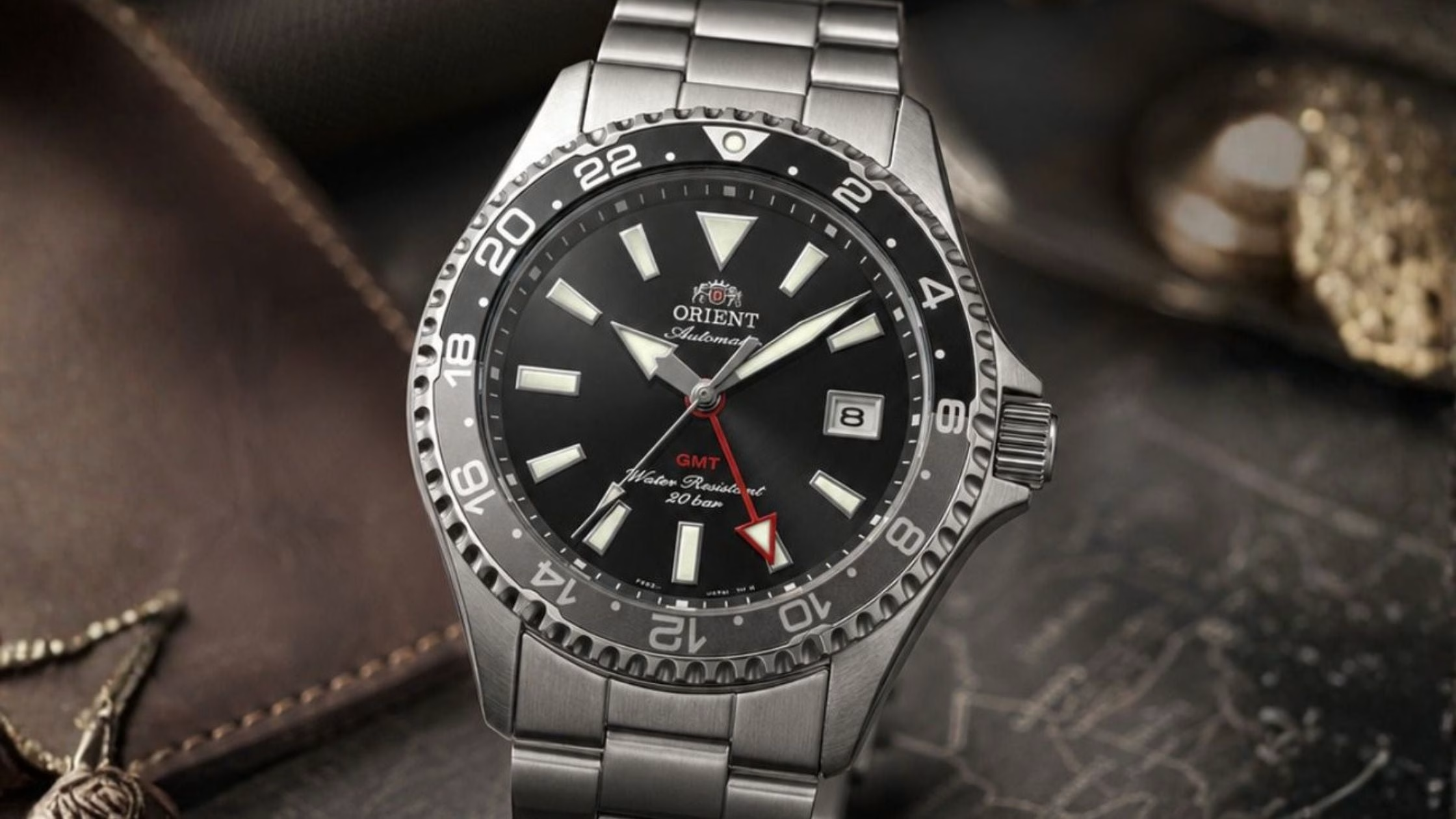
The case is where Orient earns the premium back. Sapphire crystal, 200 metres of water resistance, a screw-down crown and screw caseback, SUS316L bracelet on a trifold deployant clasp with a push-button release and a security latch, 22mm lugs. Seiko still ships the 5 Sports GMT with Hardlex and 100 metres, and its clasp is the usual stamped 5 Sports affair. Point by point, the Orient is the more solidly built object.
Dimensions are 42.8mm wide, 13.4mm thick and 49.5mm lug to lug. That last number is the one to watch. Seiko’s SSK001 is fractionally wider at 42.5mm but only 46mm from lug tip to lug tip, so it wears noticeably shorter. Nearly 50mm of lug span puts the Orient out of reach for a lot of wrists under 17cm, and this is a bezel diver, not a flat-back dress case that can hide it.


Rated accuracy is quoted at plus 25 to minus 15 seconds per day, which reads badly on paper. In practice Orient’s F6 family tends to land well inside that window, and the Bambino I have been wearing since it was a gift has held around plus 10 seconds a day without a regulation. Power reserve is over 40 hours, with hand-winding and hacking, which the Seiko matches at 41.
Five Dials, and the Orange Is the One Worth Talking About
The regular run covers black (RA-BC0001B), green (RA-BC0002E), navy blue (RA-BC0003L) and orange (RA-BC0004Y), each with a two-tone 24-hour bezel colour-matched to the dial. The limited edition (RA-BC0005L) gets a blue gradation dial Orient describes as the sky seen from a plane, a black-plated bezel, and the dolphin icon plus a serial number engraved on the caseback, capped at 4,000 pieces.

Three of those four regular dials are the colours every Japanese diver already comes in. The orange is the one that justifies a photograph, and it is the only variant in the set that a buyer who already owns something from Orient’s cheaper end of the dive catalogue would have a real reason to add. The limited edition is the most conventionally attractive of the five, though a 4,000-piece run at a $39 premium is a soft kind of scarcity.
The Price Is Where the Argument Gets Hard
At $673 the Mako GMT does not sit next to the Seiko 5 Sports GMT, it sits well above it. Seiko lists the SSK001 at $495 and it is routinely discounted below $400, which puts the gap somewhere between $180 and $280 depending on the day. Seiko has also been extending the format downwards in size rather than upwards in price: the khaki and desert sand field versions that arrived this summer squeeze the same idea into a 39.4mm case at 490 euros.
So Orient is charging a substantial premium for a watch that is physically better made and functionally less useful. At a $40 difference that would be an easy call, and at nearly $200 it might not be.

If the second time zone is decoration, something you glance at for a partner’s time zone twice a month, the bezel method costs you nothing and you are buying sapphire, 200 metres and a proper clasp with the difference. If you actually reset a second zone in an airport, the Seiko will annoy you less every single time and leave you with most of $200.
Specs, Pricing & Availability
Case Diameter: 42.8 mm
Case Thickness: 13.4 mm
Case Material: Stainless steel (SUS316L)
Water Resistance: 200 m (20 bar)
Caliber: Orient F6P22, automatic with hand winding, 22 jewels, over 40 hours power reserve, +25 to -15 seconds per day
Crystal: Sapphire
Function: Hours, minutes, seconds with hacking, date, 24-hour hand for a second time zone set via the unidirectional 120-click rotating bezel
Price: $673 (limited edition RA-BC0005L, $712)
Who Should Buy It and Who Should Wait
I would buy the orange one, and I would buy it as a diver that happens to track a second zone rather than as a travel watch. The case, crystal and bracelet are worth the 40 euro gap over Seiko on their own, and Orient making an in-house GMT caliber at all is the more important story here than the mechanism it chose for the first version.
What I would not do is buy it expecting it to replace an SSK001 for someone who travels. Orient has shipped a very good watch with a deliberately old-fashioned complication, and the version worth waiting for is the F6P22 with an independently settable hand, which is now clearly within the brand’s reach. Seiko’s grip on the affordable GMT does not loosen this year, but it is the first time in four years that Orient has given it something to look at.
Check out The Ultimate Affordable Watches Guide